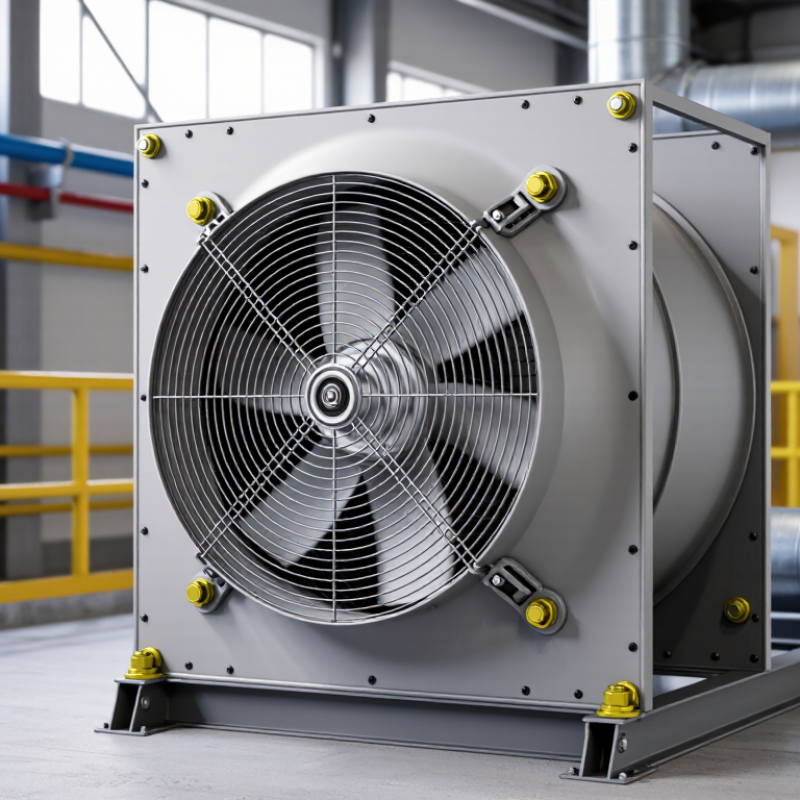
| Ingress Protection | IP55
First digit 5: dust-protected enclosure.
Second digit 5: protection against water jets from any direction. | IP66
First digit 6: dust-tight enclosure.
Second digit 6: protection against powerful water jets from any direction. | Resistance of the complete enclosure to specified solid-particle and water ingress conditions under IEC 60529. | IP test report or certificate identifying the exact fan model, enclosure configuration, test method, and test conditions. | IP66 is generally preferable for outdoor, washdown, coastal, dusty, or heavy-process environments. IP rating alone does not prove explosion protection. |
| Explosion Protection | Applicable protection concept selected according to the hazardous area classification, gas or dust group, and equipment protection level. | Certification covering the intended jurisdiction and the complete electrical and mechanical configuration, including motor, terminal box, cable entries, and accessories. | Suitability for use in a defined potentially explosive atmosphere when installed according to the certificate and instructions. | Valid certificate, product marking, installation instructions, protection concept, ambient-temperature range, and limitations of use. | Do not accept “explosion proof” as a standalone claim. Match the equipment marking to the site zone, substance, temperature class, and protection level. |
| IECEx / IEC 60079 Framework | Relevant IEC 60079 requirements for construction, testing, marking, and use in explosive atmospheres. | Independent conformity assessment under an internationally recognized certification scheme, where required by the project or destination market. | Evidence that the certified equipment has been assessed against applicable explosive-atmosphere protection requirements. | Certificate number, equipment marking, protection type such as Ex d, Ex eb, Ex ec, Ex tb, or other applicable concept, and certificate schedule. | Confirm whether the certificate covers gas, dust, or both. Gas and dust applications use different protection and temperature considerations. |
| ATEX Market Access | For applicable European Union equipment, conformity with Directive 2014/34/EU may be required before placing the product on the market. | Correct equipment group, category, marking, technical file, declaration of conformity, and quality-assurance route for the intended application. | Regulatory conformity for equipment and protective systems intended for potentially explosive atmospheres in the European Union. | EU Declaration of Conformity, ATEX certificate where applicable, technical marking, and instructions in the required languages. | ATEX documentation is not interchangeable with an IP test report. Both may be required for a complete procurement package. |
| Fan Performance Testing | Testing in accordance with ISO 5801 using standardized airways and defined test conditions. | A complete performance curve covering airflow, pressure, speed, power input, efficiency, and sound data for the specified configuration. | Repeatable fan aerodynamic performance data suitable for comparing operating points and system resistance. | ISO 5801 test report, fan curve, test-air-density information, measurement uncertainty, rotational speed, and configuration details. | Select the duty point from the system curve rather than choosing a fan by nominal diameter or free-air airflow alone. |
| Airflow and Pressure Selection | Required airflow in m³/h or CFM and required static or total pressure in Pa or inH₂O. | Operating point positioned within the stable region of the certified performance curve, with suitable margin for filters, louvers, ducts, dampers, and process resistance. | The fan can meet the required ventilation duty under actual system resistance. | System resistance calculation, duct layout, filter pressure drop, fan curve, operating speed, and motor rating. | Avoid comparing airflow values measured at different pressures or under different test conditions. |
| Motor and Electrical System | Supply voltage, frequency, phase, rated current, starting method, duty rating, and motor temperature limits must match the installation. | Certified motor and compatible control equipment, with overload protection, appropriate cable glands, earthing, and documented temperature limits. | Electrical compatibility and safe operation within the declared supply and environmental conditions. | Motor nameplate data, wiring diagram, certificate, efficiency data, insulation class, ingress rating, and protective-device requirements. | Verify variable-frequency-drive compatibility separately; not every explosion-protected motor or fan assembly is approved for inverter operation. |
| Temperature and Material Compatibility | Ambient temperature, transported-air temperature, humidity, corrosive exposure, and material compatibility must be defined. | Documented maximum surface temperature or temperature class, suitable impeller and housing materials, and corrosion-resistant finish where required. | The fan is suitable for the thermal and chemical conditions declared for the application. | Temperature-class information, material specification, coating data, chemical-compatibility statement, and operating limits. | Check both the motor surface temperature and the fan’s internal or external ignition-risk limitations. |
| Mechanical Safety | Guarding, rotating clearances, vibration control, shaft and bearing arrangement, and mounting integrity must be suitable for the duty. | Factory balancing, documented vibration limits, replaceable bearings where applicable, and maintenance access without compromising certified protection. | Mechanical reliability and reduced risk from contact, excessive vibration, friction, or component failure. | Balance report, vibration data, bearing specification, maintenance instructions, guard dimensions, and mounting drawings. | Confirm that replacement parts and maintenance procedures preserve the certified configuration. |
| Noise and Energy Performance | Sound-pressure or sound-power data measured using a stated method and operating point. | Efficiency data, motor efficiency class where applicable, optimized impeller geometry, and documented acoustic performance. | A basis for evaluating worker exposure, equipment-room noise, energy consumption, and lifecycle cost. | Acoustic test conditions, sound-power spectrum, input power, efficiency, speed, and airflow-pressure operating point. | Noise values are meaningful only when the distance, room conditions, frequency weighting, and operating point are stated. |
| Outdoor and Washdown Use | Minimum enclosure rating suitable for expected rain, dust, and cleaning exposure; IP55 is a common baseline. | IP66 enclosure, corrosion-resistant materials or coating, protected cable entries, drainage provisions, and suitable installation orientation. | Improved resistance to dust and water exposure under IEC 60529 test conditions. | IP test report, enclosure drawings, cable-gland rating, coating specification, and installation limitations. | Neither IP55 nor IP66 guarantees resistance to immersion, high-temperature steam, chemicals, or continuous water submersion. |
| Documentation and Traceability | Model identification, serial or batch traceability, installation manual, wiring diagram, and maintenance schedule. | Complete technical file containing certificates, test reports, drawings, spare-parts list, inspection records, and change-control information. | The supplied unit can be linked to the tested and certified configuration. | Nameplate photograph, certificate scope, conformity declaration, ISO 5801 report, IEC 60529 report, and approved drawings. | Treat missing or mismatched documentation as a procurement risk, even when the fan has the required airflow and IP marking. |

.svg)