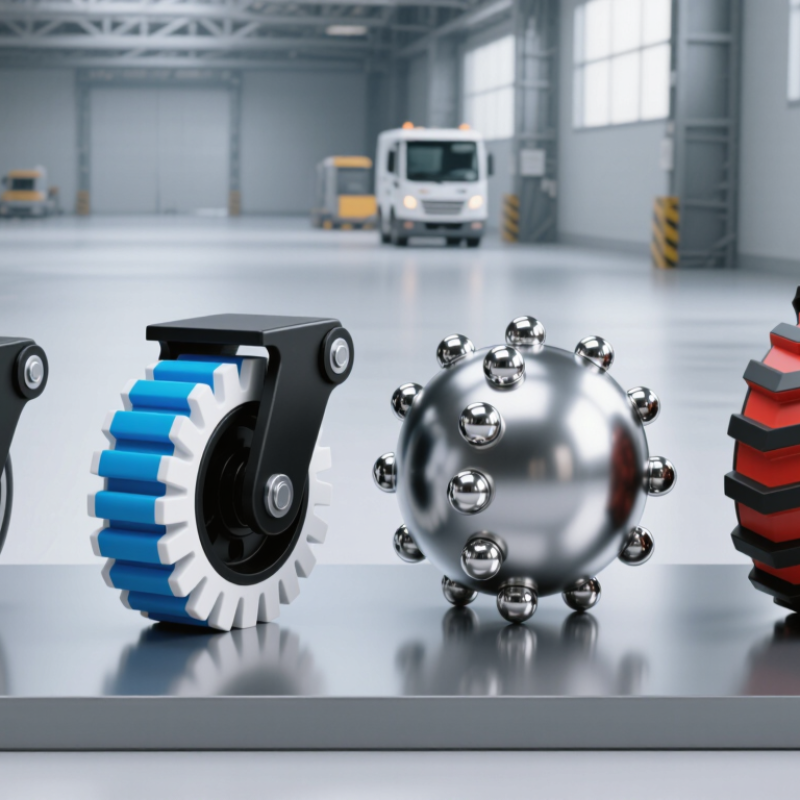
| Ball Transfer Unit | A large load-bearing ball rotates on smaller supporting balls or an internal race. | Free movement in multiple horizontal directions, including 360-degree positioning. | Approximately 20–2,500 kg, depending on ball diameter, housing, and construction. | Material handling tables, transfer stations, airport and warehouse equipment, and assembly lines. | Very low directional resistance and simple multidirectional transfer. | Usually requires a flat, rigid load surface; exposed units can be affected by dirt and impact. | Ball diameter, housing material, corrosion resistance, mounting method, surface cleanliness, and static versus dynamic load rating. |
| Single-Row Omni Wheel | A central wheel is fitted with rollers around its circumference, with roller axes generally perpendicular to the wheel axis. | Forward and lateral movement when used in a properly arranged wheel system. | Approximately 10–250 kg, depending on wheel diameter, roller design, and frame support. | Small mobile robots, conveyor systems, inspection equipment, and light-duty platforms. | Compact design, relatively small turning envelope, and good lateral maneuverability. | Individual rollers can create vibration on uneven floors and may have limited point-contact traction. | Roller material, roller spacing, wheel diameter, axle strength, floor flatness, noise, and allowable shock load. |
| Dual-Row Omni Wheel | Two offset rows of rollers distribute contact across a wider wheel profile. | Multidirectional travel with improved stability and load distribution compared with many single-row designs. | Approximately 50–1,000 kg, depending on diameter, roller width, and bearing arrangement. | Automated guided vehicles, warehouse carts, robotic platforms, and medium-duty transfer systems. | Higher stability, better load support, and reduced risk of edge contact under moderate loads. | More expensive and heavier than basic single-row wheels; requires accurate alignment. | Total wheel width, roller geometry, load sharing, bearing protection, mounting tolerance, and floor condition. |
| Mecanum Wheel | Angled rollers, commonly arranged at approximately 45 degrees, convert wheel rotation into longitudinal and lateral force components. | Forward, reverse, lateral, diagonal, and spot-rotation movement when four or more wheels are controlled as a system. | Approximately 50–1,500 kg per wheel, depending on wheel size, roller construction, and drive system. | Mobile robots, autonomous transport vehicles, industrial platforms, and indoor logistics equipment. | Provides true holonomic movement without steering the wheel assembly. | Higher control complexity, reduced efficiency during lateral travel, and sensitivity to uneven or contaminated floors. | Wheel orientation pattern, motor torque, encoder feedback, roller hardness, traction, control software, and floor flatness. |
| Spherical Wheel | A spherical load-bearing element rotates within a socket, ring, or powered support mechanism. | Potential movement in multiple directions from a single wheel position, depending on the support and drive design. | Approximately 20–500 kg for compact industrial designs; capacity varies widely by support structure. | Specialized robots, compact maneuvering platforms, positioning equipment, and research systems. | Highly compact footprint and flexible directional response. | Less common, more specialized, and often more sensitive to surface quality and bearing contamination. | Sphere material, socket design, drive method, sealing, friction management, serviceability, and load stability. |
| Powered Omni-Directional Drive Module | Integrates an omni-directional wheel with a motor, gearbox, bearings, and mounting structure. | Controlled translation and rotation through coordinated drive modules. | Approximately 50–2,000 kg per module, depending on motor torque, gearing, wheel size, and duty cycle. | Autonomous mobile robots, production-line transporters, heavy-duty indoor vehicles, and precision positioning platforms. | Combines mechanical mobility with integrated control, braking, and feedback options. | Higher purchase cost, electrical integration requirements, and greater maintenance complexity. | Rated torque, continuous and peak load, duty cycle, motor voltage, encoder type, brake function, ingress protection, and control interface. |
| Heavy-Duty Omnidirectional Transfer Wheel | Uses large rollers or a heavy-duty ball arrangement to support and redirect substantial loads. | Manual or powered multidirectional transfer across industrial platforms and fixed handling stations. | Approximately 500–5,000 kg per wheel or unit, subject to installation and load distribution. | Steel handling, machine loading, fabrication lines, pallet transfer, and heavy industrial assembly. | High load capacity, robust construction, and suitability for demanding industrial environments. | Large installation space, higher rolling resistance under heavy loads, and significant foundation requirements. | Safety factor, dynamic impact load, mounting plate strength, floor capacity, corrosion protection, lubrication, and replacement access. |

.svg)