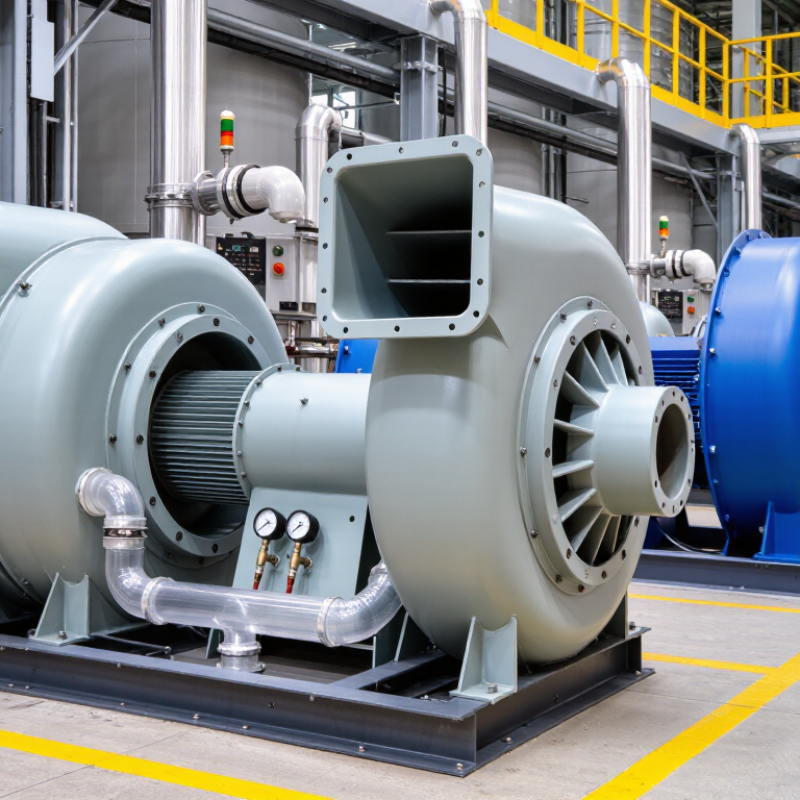
| Conventional Tri-Lobe Roots Blower | Two counter-rotating, non-contacting tri-lobe rotors transport nearly constant air volume from the inlet to the discharge side. | Positive pressure: commonly up to about 1.0 bar(g), depending on speed, cooling, and configuration.
Vacuum: commonly up to about 0.5 bar(g) vacuum. | Approximately 100 to 10,000 m³/h, depending on frame size and operating speed. | Simple construction, reliable continuous operation, easy maintenance, and good suitability for stable flow requirements. | Higher pulsation and noise than multi-lobe or internally compressed designs; efficiency decreases as pressure ratio rises. | Wastewater aeration, pneumatic conveying, aquaculture, cement handling, grain conveying, and industrial air supply. | Confirm required flow at actual operating pressure, motor power, maximum speed, inlet filtration, discharge temperature, relief protection, and service availability. |
| Helical Tri-Lobe Roots Blower | Tri-lobe rotors with a helical profile reduce the volume of each discharge pulse and provide smoother gas transfer. | Positive pressure: commonly up to about 1.0 bar(g).
Vacuum: commonly up to about 0.5 bar(g) vacuum. | Approximately 200 to 12,000 m³/h, subject to model size, speed, and pressure conditions. | Lower pulsation, reduced vibration, and generally lower noise than straight-lobe designs at comparable operating conditions. | More complex rotor geometry and potentially higher purchase cost; performance still depends strongly on pressure ratio and clearances. | Municipal and industrial wastewater treatment, pneumatic conveying, chemical processing, and applications requiring smoother airflow. | Compare sound pressure, vibration, specific power consumption, rotor balance, allowable duty cycle, and performance at the buyer’s actual altitude and ambient temperature. |
| Two-Lobe Roots Blower | Two counter-rotating lobes move fixed volumes of gas without internal compression. | Positive pressure: commonly up to about 0.8 bar(g).
Vacuum: commonly up to about 0.5 bar(g) vacuum. | Approximately 50 to 8,000 m³/h, depending on frame size and speed. | Robust, mechanically straightforward, widely understood by maintenance teams, and suitable for intermittent or moderate-duty service. | More airflow pulsation and acoustic noise; often less energy-efficient than tri-lobe or internally compressed alternatives at higher pressure. | Low-to-moderate pressure conveying, small and medium wastewater systems, gas boosting, and general industrial air service. | Check whether pulsation is acceptable, whether a silencer or pulsation damper is needed, and whether the selected model can operate continuously at the required pressure. |
| Internally Compressed Roots-Type Blower | The rotor profile provides limited internal compression before the gas reaches the discharge port, reducing backflow and compression losses. | Often suitable for positive-pressure duties above conventional low-pressure limits; the exact range is design-specific and must be verified from the performance curve. | Approximately 300 to 15,000 m³/h for large industrial configurations. | Lower specific energy consumption than a conventional Roots blower in suitable pressure-ratio applications; smoother discharge and reduced temperature rise. | Higher engineering complexity, tighter operating requirements, and greater sensitivity to incorrect selection or contaminated gas. | High-volume aeration, process gas handling, pneumatic conveying, and continuous industrial duties where energy cost is important. | Request certified performance data showing power, flow, discharge temperature, pressure ratio, turndown capability, and efficiency at the complete operating envelope. |
| Oil-Free Roots Blower Package | The compression chamber is isolated from lubricating oil; bearings and gears are lubricated separately from the transported gas path. | Usually selected for low-pressure air or gas service; allowable pressure and vacuum depend on the specific package design. | Approximately 100 to 20,000 m³/h across small to large industrial packages. | Prevents oil contamination of the conveyed medium and can satisfy clean-air requirements when correctly filtered and maintained. | Oil-free does not mean maintenance-free; inlet contamination, moisture, temperature, and seal condition can affect reliability. | Wastewater aeration, food and beverage utilities, pharmaceutical processes, electronics manufacturing, and clean pneumatic conveying. | Verify the required air-quality class, materials of construction, sealing method, filtration level, condensate management, and documentation for hygienic or regulated applications. |
| Water-Cooled or High-Temperature Roots Blower | A Roots-type air end is combined with additional thermal management to control casing, bearing, or discharge temperatures during demanding operation. | Pressure and vacuum limits are application-specific; continuous operation at the required pressure must be confirmed using corrected performance data. | Approximately 500 to 20,000 m³/h for large continuous-duty installations. | Better temperature control for high ambient temperatures, high pressure ratios, or extended continuous operation. | Requires cooling-water quality or additional cooling equipment; installation and maintenance are more demanding. | Industrial process air, mineral processing, chemical plants, high-temperature conveying, and large wastewater facilities. | Check cooling-water flow and quality, heat rejection, corrosion protection, ambient conditions, emergency shutdown logic, and the total lifecycle cost. |
| Variable-Speed Roots Blower System | A Roots blower is driven by a variable-frequency drive or another speed-control system so that airflow follows changing process demand. | Pressure and vacuum limits remain governed by the blower air end; operating speed must stay within the manufacturer’s allowable range. | Typically operated over a controllable range of about 40% to 100% of rated speed, subject to minimum speed, motor, and process limits. | Improved turndown, reduced unloading losses, better process control, and potential energy savings when demand varies significantly. | Higher control-system complexity; operation below minimum speed or outside the efficient range may cause overheating or unstable performance. | Variable-load wastewater aeration, centralized conveying, vacuum systems, and process plants with changing production demand. | Evaluate the actual load profile, minimum and maximum flow, drive efficiency, harmonic mitigation, motor cooling, control signals, bypass requirements, and grid compatibility. |

.svg)