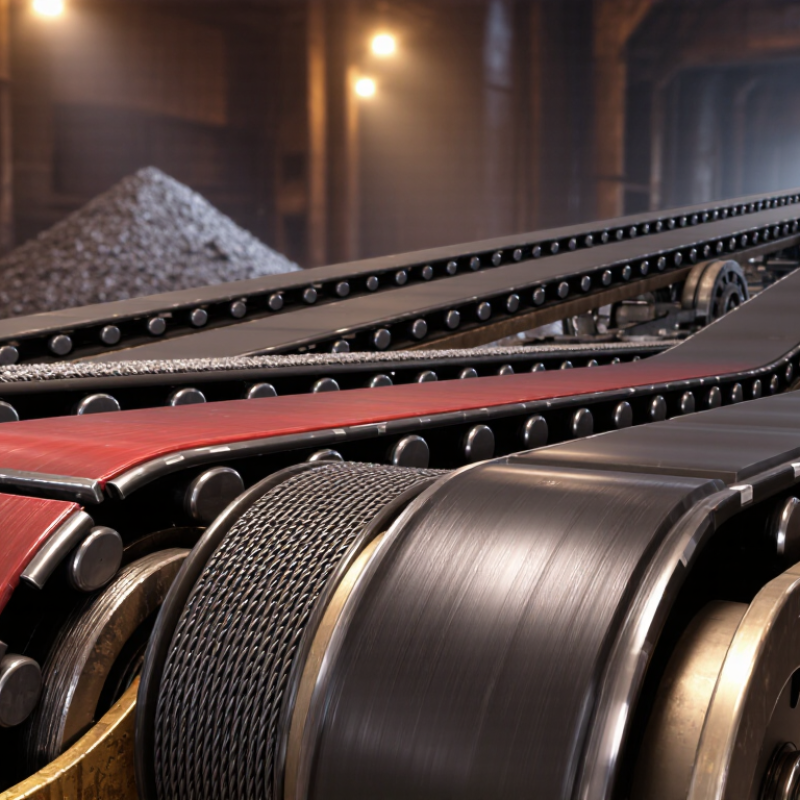
| Standard Steel Cord Belt | Longitudinal high-tensile steel cords embedded in a rubber core with transverse reinforcement and protective covers. | Long-distance bulk-material conveying, mining, quarrying, ports, power generation, and general heavy-duty service. | High tensile strength, low elongation, long conveying capability, and relatively low take-up travel compared with textile belts. | Requires careful splicing, alignment, and protection against severe impact or sharp material. | Calculate belt tension, conveyor length, incline, material density, starting load, pulley diameter, and required safety factor. |
| High-Tensile Steel Cord Belt | Higher-grade or larger steel cords arranged to provide greater rated tensile strength per unit belt width. | Very long overland conveyors, high-capacity mines, steep terrain routes, and systems with high starting or acceleration forces. | Supports high belt tensions and large conveying capacities while reducing the need for multiple conveyor sections. | Higher purchase and installation costs; splice design and dynamic tension analysis become more critical. | Use when calculated operating tension approaches the practical limit of a lower-strength belt; verify pulley and splice ratings. |
| Impact-Resistant Steel Cord Belt | Steel cord carcass combined with thicker top cover rubber, enhanced breaker layers, or special impact-resistant compounds. | Primary crushers, underground loading points, hard-rock mines, and transfer points handling large, angular lumps. | Improved resistance to cuts, gouges, punctures, and impact damage at loading zones. | Extra cover thickness can increase belt mass, flexing resistance, and running energy consumption. | Specify lump size, drop height, loading-zone design, impact energy, chute angle, and the condition of the material. |
| Abrasion-Resistant Steel Cord Belt | Steel cord carcass with cover compounds formulated for resistance to sliding and cutting abrasion. | Conveying iron ore, copper ore, limestone, clinker, coke, aggregate, sand, and other abrasive bulk materials. | Longer cover life under abrasive conditions and better resistance to wear caused by continuous material contact. | A highly abrasion-resistant cover is not automatically the best choice for severe impact, heat, or oil exposure. | Assess material abrasiveness, particle shape, moisture, belt speed, loading method, and expected cover-wear rate. |
| Heat-Resistant Steel Cord Belt | Steel cord carcass with heat-resistant rubber covers designed for elevated material and operating temperatures. | Cement plants, steel mills, foundries, sinter plants, clinker handling, hot ash systems, and mineral-processing facilities. | Better resistance to thermal aging, cover hardening, cracking, and adhesion loss at elevated temperatures. | Heat resistance is compound-specific; prolonged exposure above the rated temperature can rapidly shorten belt life. | Specify continuous and peak material temperatures, exposure duration, particle size, cooling time, and return-side temperature. |
| Flame-Retardant Steel Cord Belt | Steel cord carcass with flame-retardant covers and, where required, antistatic properties for regulated environments. | Underground coal mines, enclosed conveyors, tunnels, and facilities where fire propagation must be controlled. | Helps limit flame spread and can reduce fire-related risks when combined with suitable conveyor safety systems. | Compliance requirements vary by country and application; flame retardance does not eliminate ignition or fire hazards. | Confirm applicable safety standards, electrical-resistance requirements, ventilation conditions, inspections, and emergency controls. |
| Oil-Resistant Steel Cord Belt | Steel cord carcass with rubber compounds designed to resist swelling, softening, and deterioration from oils or oily materials. | Coal preparation, recycling, fertilizer handling, grain processing, wood products, and conveyors exposed to petroleum-based substances. | Improved dimensional stability and cover durability where mineral oils, lubricants, or oily feedstocks contact the belt. | Resistance depends on the specific oil or chemical; some vegetable oils, solvents, and additives require separate compatibility testing. | Identify the exact liquid or contaminant, concentration, temperature, contact frequency, and whether the exposure is intermittent or continuous. |
| Cold-Resistant Steel Cord Belt | Steel cord carcass with low-temperature rubber compounds that maintain flexibility in cold operating environments. | Outdoor mining, stockyards, northern regions, refrigerated areas, and seasonal operations subject to sub-zero temperatures. | Better flexibility and reduced risk of cover cracking or stiffness during cold starts and low-temperature operation. | Cold resistance does not replace requirements for abrasion, impact, heat, or oil resistance. | Specify minimum ambient temperature, material temperature, startup conditions, storage conditions, and pulley flexing requirements. |
| Rip-Detection Steel Cord Belt | Steel cord belt incorporating conductive loops, sensor-compatible elements, or other longitudinal-tear detection features. | High-capacity conveyors where a longitudinal rip could cause extensive material loss, downtime, or safety risk. | Can provide early warning of belt damage and support faster shutdown, inspection, and maintenance decisions. | Requires compatible detection equipment, correct system calibration, and regular testing to maintain reliability. | Evaluate conveyor criticality, detection coverage, sensor spacing, response time, integration requirements, and maintenance capability. |
| Energy-Optimized Steel Cord Belt | Steel cord carcass paired with low rolling-resistance covers or optimized rubber compounds and belt geometry. | Long overland conveyors, high annual operating-hour systems, and conveyors where electricity consumption is a major cost. | May reduce indentation rolling resistance and operating power when matched with suitable idlers, loading, and belt tension. | Energy savings depend on the complete conveyor system and may be offset by unsuitable idlers, misalignment, or poor loading conditions. | Compare indentation rolling resistance, belt mass, cover thickness, idler spacing, belt speed, annual hours, and lifecycle cost. |
| Pipe Conveyor Steel Cord Belt | Flexible steel cord belt designed to overlap and form a closed pipe around the conveyed material, often with transverse stiffness elements. | Enclosed transport through environmentally sensitive areas, steep routes, complex terrain, and systems requiring reduced spillage. | Limits dust and spillage, allows curved routing, and can protect material from wind or external contamination. | Requires specialized forming sections, correct overlap, precise alignment, and careful control of belt stiffness and cover properties. | Check pipe diameter, material capacity, route curvature, transition length, filling ratio, minimum radii, and cleaning requirements. |
| Sidewall Steel Cord Belt | Steel cord base belt fitted with corrugated sidewalls and cleats or crossbars for steep-angle conveying. | Inclined or vertical conveying where floor space is limited and conventional trough conveyors cannot achieve the required lift. | Enables high-angle conveying and can reduce the number of transfer points and the required footprint. | Sidewalls and cleats require inspection; loading, cleaning, transition, and pulley geometry are more specialized. | Determine lift height, inclination, capacity, material flowability, cleat spacing, sidewall height, and transfer arrangement. |
| Customized Multi-Property Steel Cord Belt | Steel cord carcass combined with selected cover, breaker, edge, and monitoring features for multiple operating hazards. | Complex installations exposed to combinations such as high tension, impact, abrasion, heat, oil, moisture, or fire regulations. | Provides a balanced solution when no single standard cover property adequately addresses the operating environment. | More complex specification, validation, procurement, and maintenance; excessive properties can increase cost without practical benefit. | Prioritize hazards by severity, define the dominant failure mode, confirm material compatibility, and compare total lifecycle cost. |

.svg)