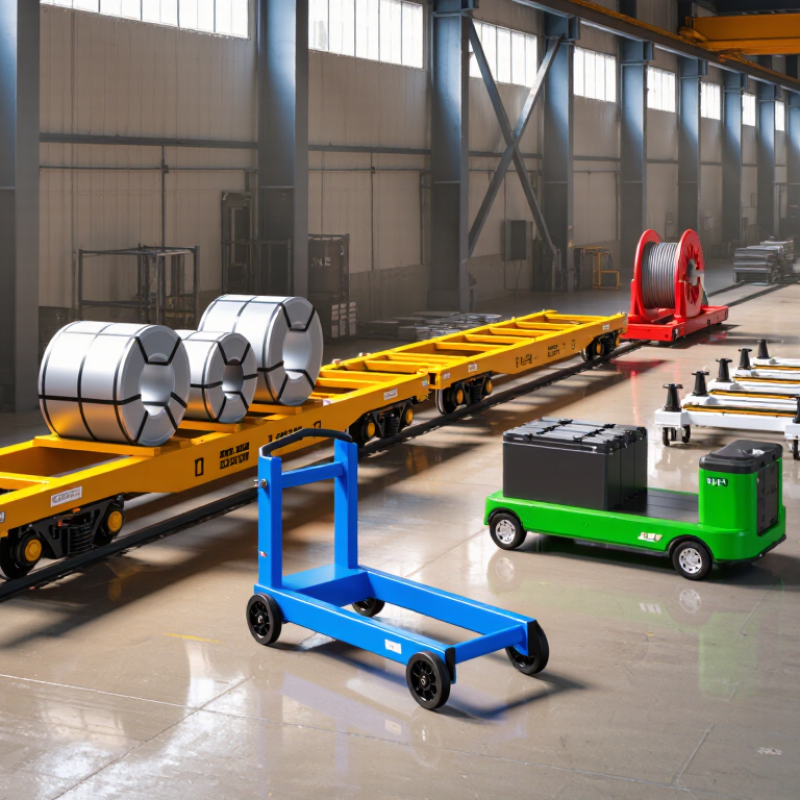
| Manual Push or Pull Cart | 0.5–5 tonnes | Manual drawbar, swivel casters, or fixed-direction wheels | Walking speed, generally below 5 km/h | Short-distance material movement, workshops, warehouses, and low-frequency handling | Confirm the required pushing force, provide a clear travel path, use wheel guards where necessary, and prevent operation on slopes beyond the approved limit. | Low complexity. Inspect casters, wheel bearings, fasteners, drawbars, brakes, and the load platform regularly. | Check floor flatness, turning clearance, caster load rating, handle dimensions, packaging size, and applicable workplace safety rules. | Low |
| Battery-Electric Steerable Cart | 1–30 tonnes | Powered steering axle, differential steering, or articulated steering | Typically 3–15 km/h, depending on load and site conditions | Indoor production lines, warehouses, assembly areas, and repeated point-to-point transport | Emergency-stop controls, audible and visual warnings, speed limitation, anti-collision detection, traction control, operator visibility, and automatic braking when power is removed. | Medium complexity. Inspect batteries, chargers, drive motors, steering components, brakes, tires, control systems, and safety sensors. | Verify local electrical standards, battery chemistry and transport rules, charger voltage and plug requirements, spare-parts availability, software support, and operator training. | Medium |
| Heavy-Duty Battery Transfer Cart | 30–200 tonnes | Multi-axle electronic steering, hydraulic steering, or coordinated wheel steering | Typically 1–8 km/h | Steel fabrication, shipbuilding, heavy machinery, precast products, and large industrial assemblies | Load-distribution verification, redundant braking, emergency-stop circuits, overload protection, anti-rollaway measures, controlled turning, travel-zone barriers, and a documented lifting and transport plan. | High complexity. Requires scheduled inspection of battery systems, hydraulic or electric steering, wheel assemblies, structural welds, brakes, controls, and load-bearing surfaces. | Confirm axle-load limits, floor-bearing capacity, transport dimensions, lifting points, export packaging, replacement battery logistics, customs classification, and local commissioning support. | High |
| Rail-Guided Transfer Cart | 5–500 tonnes | Steel rails or embedded track with mechanically or electrically controlled steering | Typically 0.5–20 km/h | Dedicated production routes, foundries, warehouses, steel plants, and repetitive heavy-load transport | Track-end protection, route interlocks, emergency stops, warning devices, guarded crossings, wheel-flange inspection, controlled access, and protection against derailment or obstruction. | Medium to high. Track alignment, rail joints, wheel flanges, drive units, brakes, electrical collectors, and route controls require periodic inspection. | Review rail gauge, foundation tolerances, installation responsibilities, floor construction, power supply, drainage, local electrical codes, and site modification requirements. | High |
| Cable-Reel or Conductor-Rail Cart | 5–150 tonnes | Rail-guided steering with cable-reel, conductor-rail, or controlled power-collection system | Typically 0.5–15 km/h | Long travel paths, high-duty-cycle factories, and applications requiring continuous electrical power | Protection from live electrical parts, cable-reel tension control, insulation monitoring, emergency isolation, guarded power collectors, route obstruction detection, and grounding verification. | Medium to high. Inspect cables, reels, collectors, insulation, drive motors, brakes, rails, connectors, and electrical enclosures. | Match voltage, frequency, enclosure rating, cable length, ambient temperature, humidity, dust level, electrical certifications, and import requirements for power equipment. | High |
| Automated Guided Transfer Cart | 1–100 tonnes | Laser guidance, magnetic guidance, QR or visual navigation, or programmed free-navigation control | Typically 1–10 km/h | Smart factories, repetitive intralogistics, line-side delivery, and operations requiring traceable routing | Safety-rated scanners, protective fields, emergency stops, safe speed control, audible and visual alerts, pedestrian detection, route management, and recovery procedures for communication loss. | High technology content. Requires battery, sensor, navigation, drive, brake, communication, and software diagnostics, plus periodic safety validation. | Check wireless regulations, cybersecurity responsibilities, network compatibility, map or route integration, data protection, language options, remote support, and availability of trained technicians. | High |
| Hydraulic Steerable Transfer Cart | 20–300 tonnes | Hydraulic cylinders controlling steerable axles or bogies | Typically 1–8 km/h | Outdoor yards, heavy fabrication, construction components, and applications with uneven operating surfaces | Hydraulic pressure protection, hose and fitting guards, controlled braking, emergency shutdown, load-stability assessment, adequate visibility, and exclusion zones during turning. | Medium to high. Inspect hydraulic hoses, seals, cylinders, pumps, fluid condition, steering joints, tires or wheels, brakes, and structural connections. | Confirm hydraulic fluid compatibility, ambient-temperature range, weather protection, road or yard surface conditions, spare hose standards, metric or imperial fittings, and service documentation. | High |
| Towed Steerable Platform Cart | 5–100 tonnes | Tow vehicle provides traction; platform uses mechanical or hydraulic steering | Usually limited to the towing vehicle's safe yard speed | Flexible indoor and outdoor logistics, modular production areas, and occasional heavy-load movement | Rated towing device, safety chains, compatible braking systems, turning-radius control, load restraint, visibility markings, and separation from pedestrians. | Medium. Inspect tow eyes, drawbars, steering linkages, wheel bearings, brakes, tires, deck condition, and load-restraint equipment. | Check towing compatibility, coupling standards, road-use restrictions, dimensions, turning envelope, local registration needs, and whether the unit will operate on public roads or private premises. | Medium |

.svg)