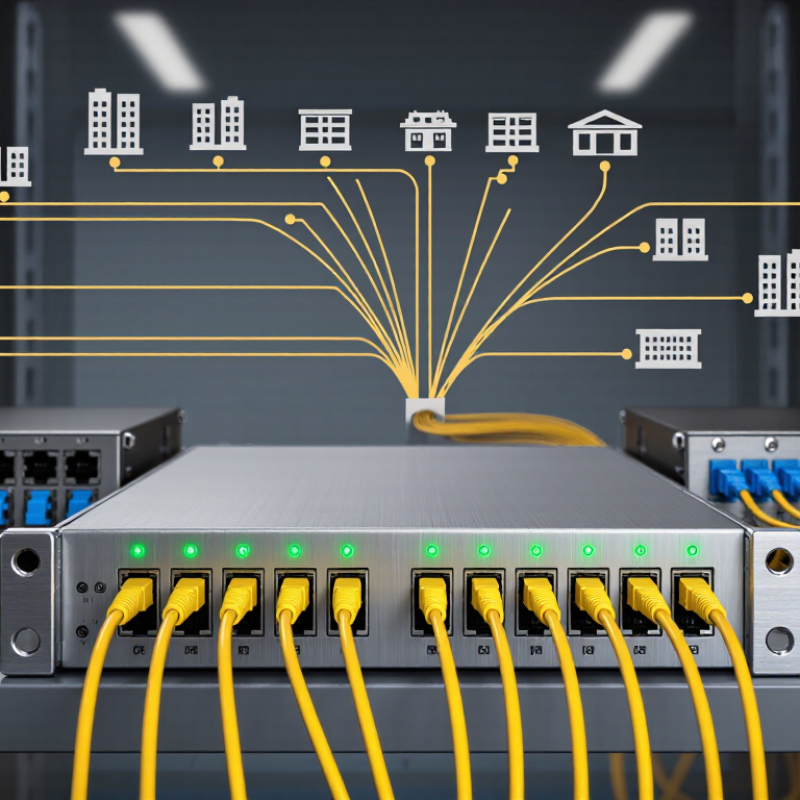
| Equipment Type | 8-port GPON OLT | An Optical Line Terminal with eight independent GPON line interfaces. Each PON port connects to a separate passive optical distribution tree and serves multiple optical network terminals or units. |
| Primary Network Role | Central-office or access aggregation device | The OLT connects the service-provider aggregation network to the passive fiber access network. It converts electrical Ethernet or service traffic into optical signals and converts received optical signals back into electrical data. |
| Number of PON Interfaces | 8 optical PON ports | Each port operates as a separate point-to-multipoint GPON segment. The total number of subscribers depends on the optical split ratio, bandwidth policy, optical budget, and traffic profile. |
| Downstream Wavelength | 1490 nm nominal | The OLT transmits downstream data toward all connected ONTs or ONUs using the GPON downstream wavelength range of approximately 1480–1500 nm. Optical splitters replicate the signal to every branch, while each subscriber device accepts only its addressed frames. |
| Upstream Wavelength | 1310 nm nominal | ONTs or ONUs transmit upstream data toward the OLT in the approximately 1260–1360 nm range, commonly centered near 1310 nm. The upstream channel uses time slots so multiple devices can share the same fiber without transmitting simultaneously. |
| Wavelength Separation | Wavelength-division multiplexing | Downstream and upstream signals travel over the same single-mode fiber in different wavelength bands. Wavelength-selective components in the OLT and ONT separate the two directions, enabling bidirectional communication on one fiber. |
| Standard Downstream Line Rate | 2.48832 Gbit/s | This is the nominal GPON downstream line rate defined by the ITU-T G.984 family. It is shared by all users connected to the same PON port rather than dedicated to one subscriber. |
| Standard Upstream Line Rate | 1.24416 Gbit/s | This is the nominal GPON upstream line rate. Actual user throughput is lower than the line rate because of protocol overhead, management traffic, bandwidth allocation, and sharing among active subscribers. |
| Downstream Access Method | Broadcast with logical addressing | Downstream GPON frames are sent over the PON tree to all optical endpoints. Encryption and logical port identifiers help ensure that each ONT or ONU receives only the traffic assigned to it. |
| Upstream Access Method | TDMA with dynamic bandwidth allocation | The OLT assigns transmission windows to ONTs or ONUs. Dynamic bandwidth allocation adjusts these time slots according to service requirements, queue status, and configured quality-of-service rules. |
| Passive Distribution Components | Optical splitters and single-mode fiber | Passive splitters divide the downstream optical signal and combine upstream signals without requiring electrical power in the outside plant. Splitter insertion loss is an important factor in determining the usable optical budget. |
| Common Split Ratios | 1:32 or 1:64; up to 1:128 in suitable designs | A 1:32 splitter can connect up to 32 optical endpoints to one PON port, while a 1:64 splitter can connect up to 64. The practical limit depends on optical class, fiber distance, connector and splice losses, and required operating margin. |
| Nominal Reach | Up to 20 km in typical GPON deployments | The actual fiber distance is limited by the optical power budget and timing requirements. Splitter loss, fiber attenuation, connectors, splices, and engineering margin must all be included in the link calculation. |
| Fiber Medium | Single-mode optical fiber | Single-mode fiber carries both 1490 nm downstream and 1310 nm upstream signals. The same physical fiber can support bidirectional communication because the two traffic directions use separate wavelength bands. |
| Subscriber Equipment | ONT or ONU | The ONT or ONU receives the 1490 nm downstream signal, transmits the 1310 nm upstream signal, performs GPON registration, and presents user-facing interfaces such as Ethernet, voice, or other access services. |
| Service Encapsulation | GEM-based transport | GPON Encapsulation Method transports Ethernet and other service payloads over the GPON framing structure. Logical service identifiers and traffic containers help the OLT apply forwarding and bandwidth policies. |
| Bandwidth Sharing | Shared per PON port | All subscribers on one PON port share the port's available downstream and upstream capacity. A properly engineered split ratio and service profile are required to maintain predictable performance during busy periods. |
| Core Traffic Flow | Aggregation network ⇄ OLT ⇄ PON fiber ⇄ ONT/ONU | Downstream traffic enters the OLT from the aggregation network and leaves through the 1490 nm optical transmitter. Upstream traffic arrives at the OLT near 1310 nm, is converted to electrical data, and is forwarded toward the aggregation network. |
| Key Design Considerations | Optical budget, split ratio, reach, and traffic demand | Reliable planning requires checking transmitter and receiver power levels, fiber and passive-component losses, endpoint count, expected concurrency, quality-of-service requirements, and available uplink capacity. |

.svg)