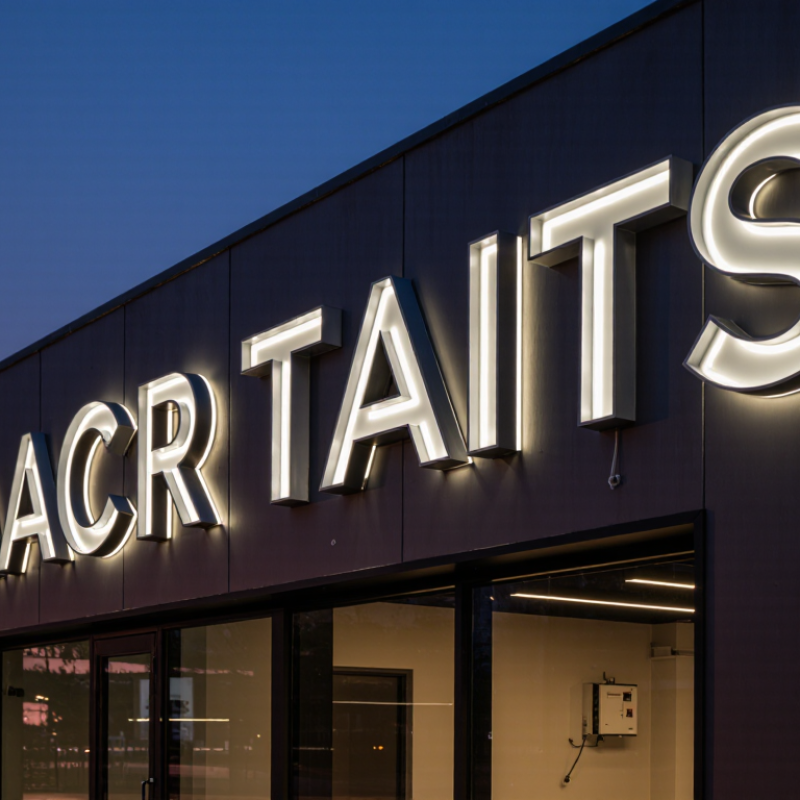
| Definition | A three-dimensional sign in which light is positioned behind individual letters or symbols. | Creates a halo or reverse-lit effect around the characters instead of illuminating only their front surfaces. |
| Typical face material | Aluminum, acrylic, stainless steel, or another weather-resistant sheet material. | Determines the letter’s appearance, stiffness, corrosion resistance, and finishing options. |
| Typical face thickness | Approximately 3–5 mm for many rigid acrylic or metal face applications. | Provides a practical balance between rigidity, weight, edge quality, and fabrication cost. |
| Letter depth | Common fabricated depths are about 50–150 mm, depending on letter size and design. | Provides space for the light source and helps control the brightness and spread of the halo. |
| Lighting source | Low-voltage LED modules or LED strips are commonly installed inside or behind the letters. | LEDs provide efficient illumination, long service life, and relatively low heat output. |
| Light direction | Light is directed toward the mounting surface, leaving a controlled gap between the letter and the wall. | The reflected light forms a visible outline or halo around each letter. |
| Typical wall clearance | Approximately 25–75 mm, depending on the desired halo width and installation conditions. | A greater clearance can broaden the light spread, while a smaller clearance produces a tighter halo. |
| Power requirement | LED systems commonly operate at 12 V or 24 V DC and require a suitably rated driver or power supply. | The power supply must match the total wattage, voltage, wiring length, and environmental conditions. |
| Energy use | LED illumination generally consumes less electricity than comparable fluorescent or neon systems. | Can reduce operating costs, especially when the sign is illuminated for long periods. |
| Halo appearance | The effect may appear as a soft outline, a narrow glow, or a broader wash of light. | Appearance depends on letter depth, wall color, mounting distance, LED spacing, and surface reflectivity. |
| Daytime visibility | The unlit face remains visible through its color, finish, shape, and dimensional projection. | A suitable face finish helps maintain readable branding or directional information in daylight. |
| Outdoor protection | Outdoor installations should use sealed components, protected wiring, drainage provisions, and weather-resistant finishes. | Improves resistance to rain, dust, condensation, ultraviolet exposure, and temperature changes. |
| Main advantages | Dimensional appearance, refined nighttime visibility, low-voltage operation, and flexible material and color choices. | Suitable for building façades, reception areas, retail locations, hospitality venues, and wayfinding applications. |

.svg)