| Forced-air cooling | A fan moves air across or through the battery pack, carrying heat away from the cells. The air may come from the surrounding environment or the vehicle cabin. | Fan or blower, air ducts, vents, temperature sensors, and control electronics. | Relatively simple and lightweight; does not require liquid coolant lines inside the pack. | Air transfers heat less effectively than liquid, so performance can be limited in high-load conditions. Airflow should be distributed evenly to reduce cell temperature differences. | Small battery packs, low-power equipment, and some hybrid or electric vehicles. |
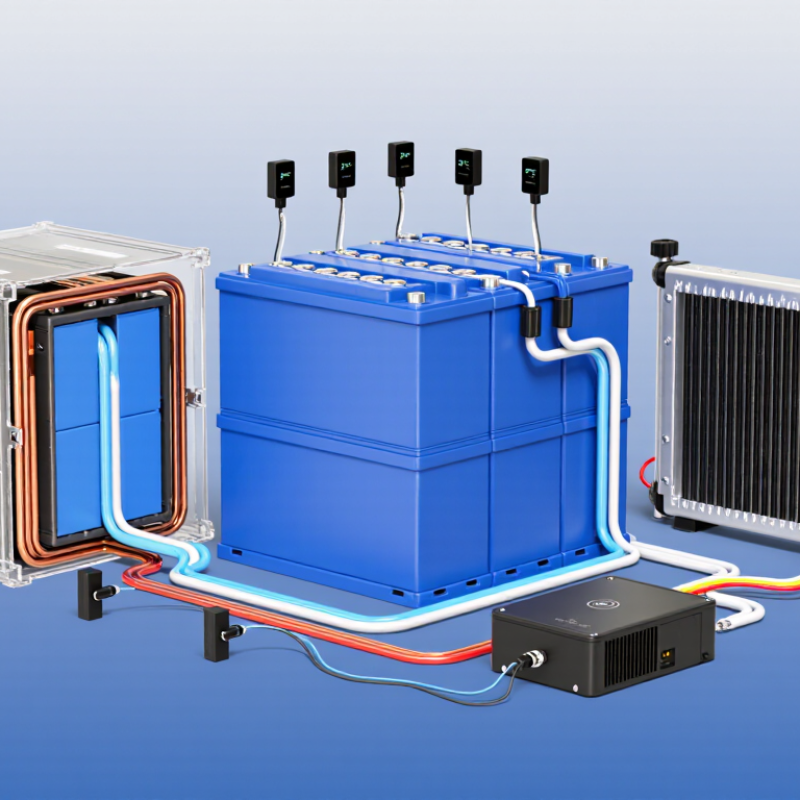
| Liquid cooling | A pump circulates coolant through channels or plates near the cells. The heated coolant passes through a Heat Exchanger, where heat is released to the surrounding air or another cooling circuit. | Coolant passages or cold plates, pump, hoses, heat exchanger, valves, sensors, and controller. | Can remove heat efficiently and help maintain more even temperatures across a high-capacity pack. | Adds parts, weight, and system complexity. The circuit must be designed to prevent leaks and manage coolant flow appropriately. | Many modern electric vehicles, energy-storage systems, and other high-power battery applications. |
| Refrigerant-based cooling | A refrigeration cycle removes heat from the battery, either through a dedicated heat exchanger or by chilling a separate coolant loop. The refrigerant absorbs heat as it evaporates and releases it elsewhere in the system. | Compressor, refrigerant lines, evaporator or chiller, condenser, expansion device, sensors, and controls. | Can provide active cooling when the battery is hotter than the surrounding air and can support temperature control in demanding conditions. | More complex than passive or fan-based cooling and uses energy to operate. System design must account for refrigerant safety and efficient control. | Electric vehicles and other systems that need active battery temperature management. |
| Phase-change material cooling | A material near the cells absorbs heat as it changes phase, commonly from solid to liquid. This stores heat temporarily and can slow the battery's temperature rise. | Phase-change material, containment structure, and heat-spreading surfaces; some designs combine it with active cooling. | Can reduce short-term temperature spikes without a continuously running pump or fan. | The material has finite heat-storage capacity and must release stored heat before it can absorb more. It is not, by itself, a continuous heat-removal system. | Battery modules and systems where passive buffering is useful, often alongside another cooling method. |
| Combined thermal management | Sensors monitor battery temperatures, and a controller adjusts fans, pumps, valves, or refrigeration equipment. Some systems also use the same thermal loop to warm a cold battery. | Temperature sensors, controller, cooling hardware, coolant circuits, and—where fitted—heating elements or heat pumps. | Can respond to changing operating conditions and help keep cells within the temperature limits specified for the battery. | Control strategy and sensor placement matter. Temperature limits and preferred operating conditions vary by cell chemistry and system design. | Battery packs that experience wide changes in load, ambient temperature, or charging conditions. |

.svg)