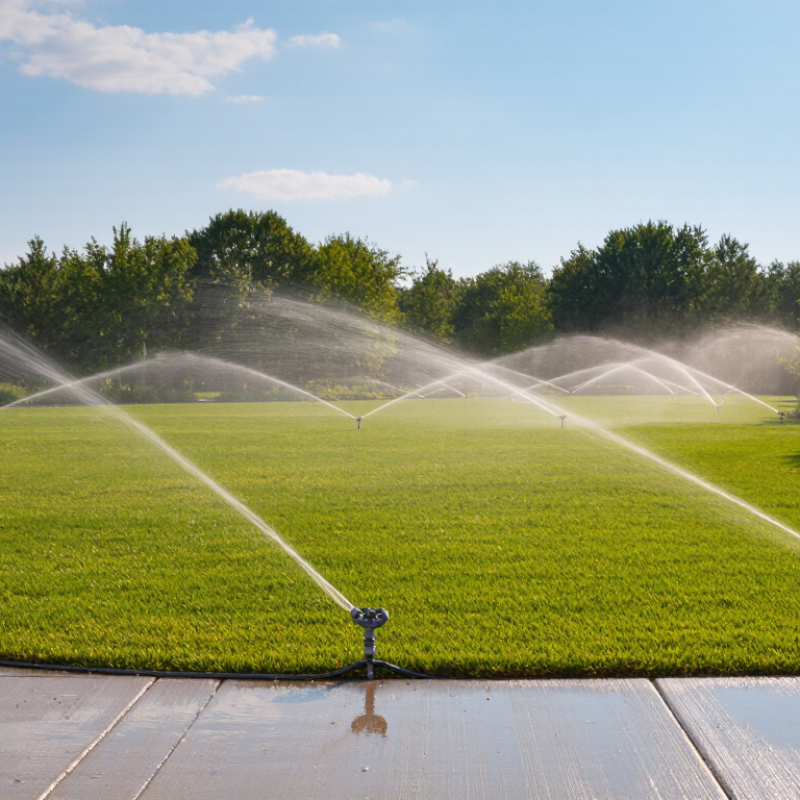
| 1 | Identify the sprinkler type | Check whether the head uses a fixed spray pattern, an adjustable arc, or a rotating stream. Use the adjustment screw or arc controls designed for that specific head. | Pattern: 90°, 180°, 270°, or 360° | The spray should remain on the intended lawn or planting area and not hit walls, sidewalks, or driveways. | More accurate coverage with less overspray. |
| 2 | Set the spray distance | Turn the radius-adjustment screw in small increments. A clockwise turn commonly reduces the throw distance, while a counterclockwise turn commonly increases it; verify the direction on the head. | Adjust in 1/8-turn increments | Measure the distance from the sprinkler to the farthest wet point while the system is running. | The spray reaches the edge of the target area without excessive runoff. |
| 3 | Adjust the spray arc | Set the left and right boundaries so the sprinkler waters only its assigned section. Keep full-circle settings for open central areas and partial arcs for borders or corners. | Arc range: 45°–360° | Watch the nozzle during a complete cycle to confirm that the pattern stops at both intended boundaries. | Fewer dry strips and less water on hard surfaces. |
| 4 | Control the water flow | Use the flow-control screw, valve, or zone valve to reduce excessive output. Make gradual changes and avoid closing a control valve so far that the head fails to rise fully. | Typical spray-head flow: about 0.5–2.0 gal/min (1.9–7.6 L/min) | The riser should pop up completely, and the spray should remain even rather than sputtering or collapsing. | Balanced precipitation and fewer puddles. |
| 5 | Match the spray pattern to the area | Use quarter-circle coverage for corners, half-circle coverage along straight edges, and full-circle coverage in open areas. Avoid mixing heads with very different application rates in the same zone. | Head spacing: typically 50%–60% of the spray diameter | Place a few straight-sided containers around the zone and compare the water depth after a short test run. | Improved head-to-head coverage and fewer dry spots. |
| 6 | Inspect pressure and nozzle condition | Clean clogged nozzles, straighten tilted heads, and check for leaks or damaged seals. If several heads spray weakly, test the zone pressure before making further adjustments. | Many spray heads operate effectively near 30–40 psi (2.1–2.8 bar) | Look for misting, uneven streams, low pop-up height, or water escaping around the stem. | More uniform spray and reliable pop-up operation. |
| 7 | Test and fine-tune the schedule | Run the system during a low-wind period, observe the complete pattern, and adjust the distance, arc, and flow again if necessary. Water deeply enough for the plants, then allow the soil surface to dry slightly between cycles where appropriate. | Test for 5–10 minutes per zone | Check soil moisture, runoff, puddling, and dry areas 30–60 minutes after watering. | Efficient watering with healthier, more evenly irrigated plants. |

.svg)