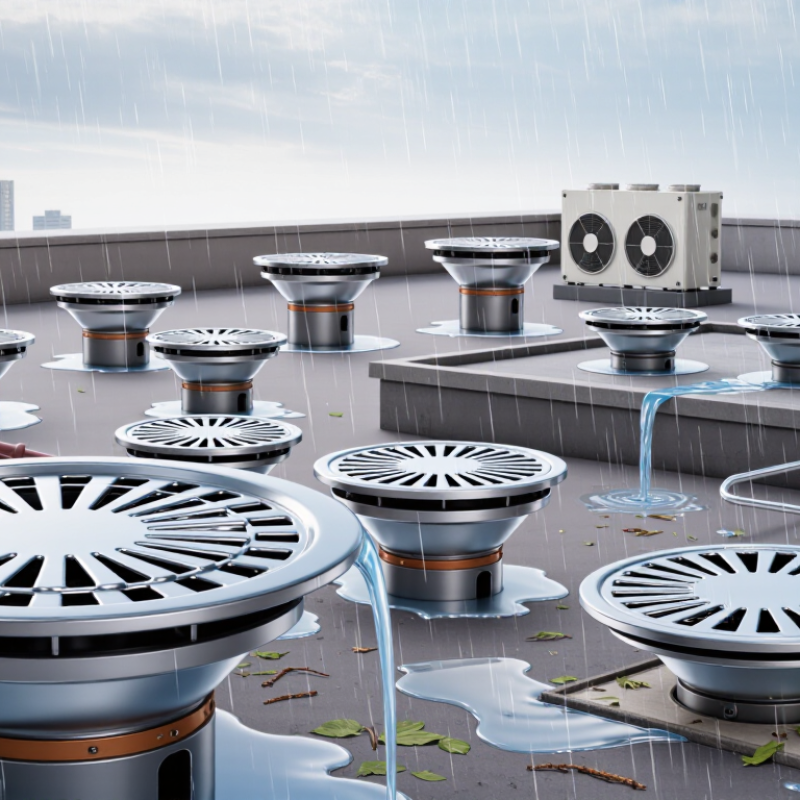
| Drain Body and Outlet | Cast iron, stainless steel, aluminum, or polymeric body with a vertical or horizontal outlet | Common nominal outlet sizes: 75, 100, 150, and 200 mm; outlet configuration should match the drainage system | Correct outlet sizing supports hydraulic capacity and simplifies connection to the building drainage network | Incompatible outlet dimensions, poor dimensional tolerance, insufficient wall thickness, or difficult site installation | EN 1253 series; ASME A112.6.3; local plumbing and building codes |
| Primary Body Material | Coated cast iron | High mass and rigidity; coating systems commonly include epoxy or other corrosion-protection layers | Good mechanical strength, low vibration, and suitability for heavy-duty roofs or trafficable areas when correctly designed | Coating damage can expose the metal to corrosion; casting defects and inadequate coating adhesion require inspection | EN 1253; ISO 12944 for corrosion-protection system classification; project-specific coating specifications |
| Corrosion Resistance | Stainless steel, typically austenitic grades such as 304 or 316L | Nominal chromium content is at least 18% for common 304/316 stainless grades; 316L contains molybdenum for improved chloride resistance | Suitable for humid, coastal, industrial, or chemically aggressive environments when the grade and finish are properly selected | 304 may be unsuitable for high-chloride exposure; dissimilar-metal contact can cause galvanic corrosion | ASTM A240/A240M; EN 10088; ISO 9227 for salt-spray testing where applicable |
| Lightweight Construction | Aluminum body and dome or grate | Low density of approximately 2.7 g/cm³; often supplied with anodized, painted, or powder-coated surfaces | Reduces handling and roof-load requirements; useful for projects prioritizing low installation weight | Lower resistance to impact and abrasion than cast iron; coating and galvanic isolation must be verified | ASTM B209/B209M; EN 573; EN 755; project-specific coating requirements |
| Polymeric Components | PVC, polypropylene, or other engineered polymer components for seals, bodies, or accessories | Low density and high resistance to many water-based chemicals; operating temperature depends on the polymer formulation | Lightweight, corrosion-resistant, and generally easy to cut or install | Thermal movement, ultraviolet exposure, brittleness at low temperature, and compatibility with roofing membranes must be evaluated | ASTM D1784 for PVC compounds; ASTM D4101 for polypropylene; EN 1253 where the complete drain assembly is covered |
| Waterproofing Flange | Clamping flange, wide membrane flange, or bonded flange designed for built-up, modified-bitumen, PVC, TPO, or EPDM systems | Flange width and surface finish should be compatible with the roof membrane and specified installation method | Reduces leakage risk by creating a continuous transition between the roof waterproofing layer and the drain | Membrane incompatibility, inadequate clamping pressure, sharp edges, and insufficient flange width | EN 1253; ASTM C1177/C1177M for glass-mat gypsum substrate where applicable; membrane manufacturer installation requirements |
| Grate or Dome | Removable dome, flat grate, or anti-vortex grate in stainless steel, cast iron, aluminum, or polymer | Free drainage area should be sufficient for the design flow; openings must limit entry of large debris while maintaining cleanability | Protects the outlet from leaves and debris and can reduce vortex formation in certain configurations | Small openings may clog quickly; inadequate fixing may allow displacement under maintenance or wind loads | EN 1253; ASME A112.6.3; project-specific debris and access requirements |
| Hydraulic Capacity | Standard-flow or high-capacity roof drain assembly | Flow rate varies with outlet diameter, head of water, grate geometry, and test method; capacity must be verified at the design head | Correctly rated drains help control ponding and support reliable stormwater discharge | Catalog flow rates may not be directly comparable when test heads or measurement methods differ | EN 1253 hydraulic performance provisions; ASME A112.6.3; local rainfall-intensity and drainage-code calculations |
| Emergency Overflow | Secondary overflow drain, scupper, or raised overflow outlet | Designed independently from the primary drain; elevation is set to limit roof-water depth during primary blockage | Provides a visible warning and protects the roof structure from excessive ponding loads | Overflow level may be too high, discharge may be directed toward façades, or the secondary path may be obstructed | International Plumbing Code provisions; International Building Code provisions; local jurisdiction requirements |
| Load and Impact Resistance | Reinforced grate or heavy-duty drain assembly | Load classification depends on the installed location; pedestrian, maintenance, and trafficable areas require different ratings | Reduces deformation and damage from maintenance equipment, foot traffic, or service vehicles | Unverified load ratings, inadequate substrate support, and mismatch between grate class and installation location | EN 124 for gully and manhole-top load classification where applicable; ASME A112.6.3; project structural requirements |
| Sealing Components | EPDM, NBR, silicone, or other elastomeric gaskets | EPDM generally performs well with weathering and hot water; NBR is often selected for oils; service temperature depends on compound formulation | Reliable seals reduce leakage at joints and membrane interfaces when correctly compressed | Incorrect elastomer selection, compression set, chemical exposure, and aging under ultraviolet radiation | ASTM D2000; ISO 3601 for O-rings where applicable; EN 681-1 for elastomeric seals in drainage applications |
| Thermal Movement | Mechanically joined body with flexible couplings or movement-tolerant connections | Linear thermal expansion differs substantially between metals and polymers; connection design must accommodate expected temperature changes | Helps prevent joint stress, cracking, and membrane separation caused by seasonal temperature variation | Rigid connections between dissimilar materials can transfer excessive stress to the drain or waterproofing layer | EN 1253; ASTM C1173 for elastomeric sealing sleeves where applicable; project movement calculations |
| Fire and Smoke Considerations | Metal drain body with compatible roof insulation and membrane system | Fire performance is determined by the complete roof assembly rather than the drain alone | Metal components generally provide good resistance to heat and flame compared with many unprotected polymers | Drain penetration details may compromise the tested roof assembly if substituted without approval | EN 13501-1; ASTM E108/UL 790 for roof-covering fire testing; local fire-code requirements |
| Quality Control and Traceability | Batch-controlled production with dimensional, material, coating, and leak inspections | Recommended records include material certificates, dimensional inspection reports, coating checks, and hydraulic or leak-test results | Improves consistency across shipments and supports project documentation and warranty claims | Untraceable raw materials, inconsistent drawings, incomplete test reports, and undocumented design changes | ISO 9001 quality-management framework; EN 10204 inspection documents; applicable product-standard test reports |
| Global Sourcing Documentation | Technical data sheet, installation manual, CAD drawings, packing list, and compliance documentation | Documents should state dimensions, materials, coating, flow-test conditions, operating limitations, and installation details | Supports engineering approval, customs classification, site installation, and cross-border quality verification | Marketing-only claims without test conditions or incomplete installation information can create approval delays | Applicable EN, ASTM, ASME, ISO, and destination-market building-code requirements |

.svg)