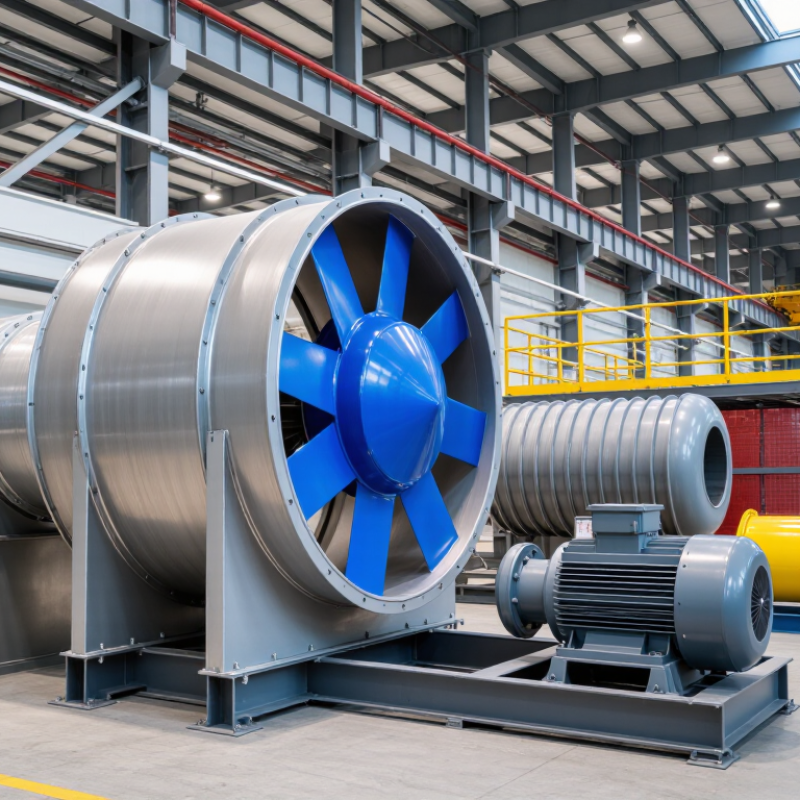
| Axial-Flow Main Mine Fan | Air is moved parallel to the rotating shaft by aerodynamically shaped blades. | Axial, generally straight through the fan casing. | Medium to high pressure, depending on blade angle, impeller diameter, and operating speed. | Primary ventilation of underground mines, shafts, declines, and large airways. | Direct-coupled motor or motor with a flexible coupling. | Reversible airflow options, adjustable-pitch blades, inlet bell, diffuser, silencer, and vibration monitoring. |
| Centrifugal Main Mine Fan | Air enters the impeller axially and leaves radially after gaining velocity and pressure. | Air typically enters axially and exits through a radial discharge outlet. | High pressure capability and stable performance against system resistance. | Deep mines, long ventilation networks, and systems requiring substantial resistance handling. | Direct drive, belt drive, or coupling drive. | Backward-curved or backward-inclined impellers, scroll casing, access doors, and outlet transition sections. |
| Auxiliary Ventilation Fan | Supplies or exhausts air through flexible or rigid ventilation ducting. | Axial flow through a duct-connected casing. | Designed for the pressure loss of headings, ductwork, bends, and auxiliary equipment. | Development headings, blind tunnels, construction faces, and localized underground work areas. | Electric motor, commonly mounted within or beside the fan assembly. | Compact housing, duct connectors, portable skids, protective guards, and staged fan installation. |
| Forced-and-Exhaust Dual-Purpose Fan | Supports either forced ventilation or exhaust ventilation according to the selected system arrangement. | Direction depends on duct connection and fan rotation or blade setting. | Selected to overcome the resistance of the connected ventilation circuit. | Flexible ventilation layouts where the same equipment may be used for supply or return air service. | Direct drive or coupling drive with suitable motor controls. | Reversible design, robust casing, directional airflow markings, and adaptable duct interfaces. |
| Reversible Axial Mine Fan | Uses an axial impeller and an airflow-reversal arrangement to change the ventilation direction. | Forward or reverse axial flow. | Pressure and efficiency can differ between normal and reversed operation. | Emergency ventilation, fire or smoke control strategies, and mines requiring operational airflow reversal. | Direct-coupled or coupling-driven motor with electrical reversing control. | Reversible impeller, symmetric casing sections, controlled start-up, and clearly defined operating limits. |
| Explosion-Protected Auxiliary Fan | Provides localized ventilation while reducing ignition risks in potentially hazardous underground atmospheres. | Usually axial flow through a connected duct system. | Matched to the pressure loss of the auxiliary ventilation circuit. | Coal mines and other areas where combustible gas or dust hazards may be present. | Certified explosion-protected motor with guarded electrical components. | Anti-static or flame-resistant duct compatibility, protected terminals, grounding provisions, and safety interlocks. |
| Jet Fan for Tunnel or Mine Ventilation | Creates a high-velocity air jet that induces and propels surrounding air without a long duct connection. | Axial discharge along the tunnel or airway. | Produces thrust rather than only static pressure in an open airway. | Large underground openings, transport tunnels, cavern ventilation, and smoke-control systems. | Reversible electric motor with direct drive. | High-velocity nozzle effect, suspension brackets, acoustic treatment, protective casing, and optional reversal control. |
| Two-Stage Axial Mine Fan | Uses two impeller stages in series to increase pressure while maintaining axial airflow. | Axial flow through both impeller stages. | Higher pressure capability than a comparable single-stage arrangement. | Long duct runs, deep mine workings, and ventilation systems with high resistance. | Single motor with mechanically connected stages or separate staged drive arrangements. | Multi-stage impeller assembly, guide vanes, inspection access, and vibration monitoring points. |
| Variable-Frequency-Controlled Mine Fan | Fan speed is adjusted electronically to match required airflow and system resistance. | Axial or centrifugal, depending on the selected fan design. | Operating pressure varies with speed and system conditions. | Energy-conscious mine ventilation, changing production zones, and demand-controlled airflow systems. | AC motor controlled by a variable-frequency drive. | Soft starting, speed regulation, reduced throttling losses, remote monitoring, and programmable protection. |

.svg)