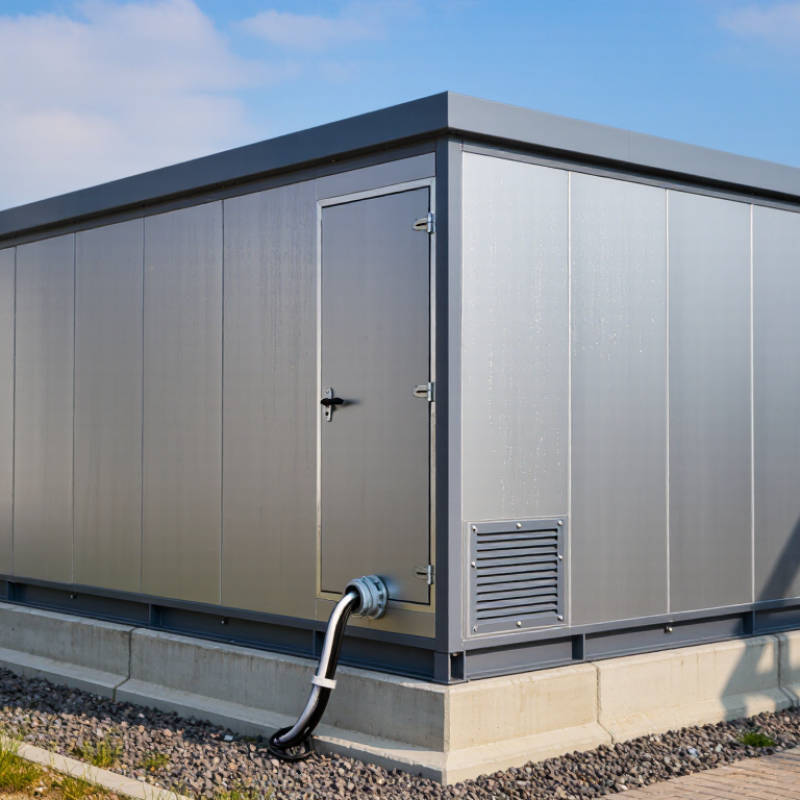
| Weatherproofing | Ingress Protection (IP) rating | IP55 provides protection against harmful dust deposits and water jets from a nozzle. | IP65 is dust-tight and protected against water jets; IP66 is dust-tight and tested against more powerful water jets. | Confirm the rating applies to the complete, assembled enclosure, including its door, gasket, cable entries, and any installed accessories. |
| Weatherproofing | Rain, wind-driven water, and installation exposure | A gasketed door and correctly sealed cable entries suit many sheltered outdoor locations. | For exposed sites, specify a suitable water-ingress rating and consider a sloped top or rain hood where offered. | Check the test conditions and installation orientation. A water-jet rating does not by itself establish suitability for immersion or every weather condition. |
| Corrosion Resistance | Steel finish and environment | Painted or powder-coated steel can suit ordinary outdoor exposure when the coating remains intact. | For coastal, industrial, or chemically exposed locations, request a finish and corrosion protection designed for that environment. | Ask for coating specifications, surface preparation details, repair guidance, and any applicable corrosion-test results. No finish is maintenance-free in every environment. |
| Temperature & Condensation | Operating conditions inside the enclosure | Allow for the equipment’s operating temperature range and heat generated by installed components. | Use a properly rated heater, thermostat, ventilation, or cooling system if calculations show a need. | Consider direct sunlight, ambient temperature, internal heat, humidity, and condensation. Ventilation openings can affect the enclosure’s ingress protection. |
| Security | Door lock and access control | A keyed quarter-turn or cam lock helps deter casual access. | Consider a multi-point latch, restricted-key cylinder, or monitored access where the site risk requires it. | Check lock compatibility, key control, latch engagement, and whether the locking arrangement is appropriate for the required security level. |
| Security | Door, hinges, and tamper resistance | Look for a rigid door, secure hinges, and a continuous gasket that is not easily displaced. | For accessible or high-risk locations, consider concealed or protected hinges and reinforced locking points. | Review door construction, hinge attachment, fastener access, and how the door behaves when fully closed and locked. |
| Access & Maintenance | Door opening and working clearance | Choose a door opening wide enough to reach terminals and serviceable components safely. | Use a larger enclosure or removable mounting panel when frequent maintenance or bulky equipment is expected. | Check the available opening angle, hinge side, nearby obstructions, and clearance needed for tools and cable bending. |
| Access & Cable Entry | Gland plate, knockouts, and cable routing | Provide cable entries sized for the installed cables and compatible with the required glands. | Consider a removable gland plate or multiple entry zones for larger cable counts or future expansion. | Confirm entry locations, gland sizes, sealing method, bend radius, and whether field-drilled openings affect the enclosure rating. |
| Installation | Mounting and load capacity | Match the mounting arrangement to the wall, pole, or support structure and the enclosure’s loaded weight. | For heavy equipment or exposed sites, specify suitable brackets and structural support for wind and vibration loads. | Check mounting-hole locations, fastener material, substrate strength, and whether the mounting method preserves drainage and sealing. |
| Electrical Safety | Bonding and grounding | Provide a suitable protective-earth connection when required by the electrical design and applicable codes. | Use designated bonding points and verify continuity across removable doors or panels where needed. | Confirm grounding provisions, local code requirements, and the installer’s responsibility for correct bonding. |
| Sizing & Future Needs | Internal space and component layout | Allow room for the equipment, wiring, cable bend radius, and safe access to terminals. | Reserve additional space for planned components, wiring separation, and future maintenance. | Check usable internal dimensions, mounting-plate size, equipment heat dissipation, and any required separation distances. |
| Documentation | Ratings and installation instructions | Use an enclosure with clear technical documentation for its ratings and installation limits. | Request test reports or certification details where the project specification or local regulations require them. | Verify the exact model, accessories, and installation conditions covered by the documentation; ratings can change when holes or components are added. |

.svg)