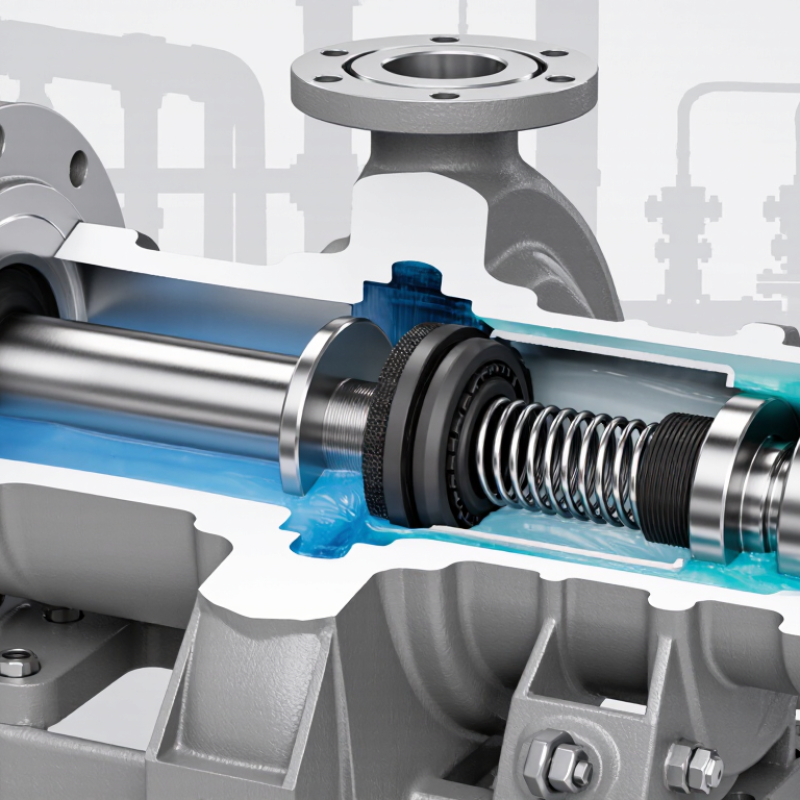
| Packed Gland Seal | Approximately 3–12 months, depending on shaft condition, adjustment, fluid abrasiveness, and operating hours | High
Requires regular packing adjustment and periodic replacement | Low | Low to moderate pressure; commonly used for water and less hazardous fluids | Controlled leakage is normally required for cooling and lubrication | Low; packing can usually be replaced without removing the pump | Generally easy to source; correct packing size, material, and installation technique are important | Basic water service, slurry duties, older equipment, and applications where limited leakage is acceptable |
| Single Mechanical Seal | Approximately 1–3 years under suitable conditions; shorter life may occur with dry running, vibration, or solids | Medium
Requires correct installation, clean faces, and periodic condition checks | Medium | Moderate pressure and temperature; compatible with many clean or lightly contaminated liquids | Very low visible leakage when properly selected and operated | Medium; shaft runout, alignment, face condition, and elastomer compatibility matter | Replacement parts should match seal dimensions, face materials, elastomers, and spring arrangement | General industrial pumps, cooling water, process water, oils, and non-crystallizing chemicals |
| Cartridge Mechanical Seal | Approximately 2–5 years in stable service with proper flushing and operating conditions | Low to Medium
Pre-assembled design reduces setup errors; routine inspection is still required | Medium to High | Moderate to high pressure and temperature, subject to material and design limits | Very low leakage when correctly selected and maintained | Low to medium; preset components simplify installation and alignment | Spare cartridges should be stocked by pump size and seal arrangement; technical fit verification is recommended | Plants seeking faster maintenance, repeatable installation, and reduced assembly-related failures |
| Double Mechanical Seal | Approximately 2–5 years when barrier fluid pressure, cleanliness, and circulation are properly controlled | Medium to High
Requires barrier or buffer system checks, pressure monitoring, and fluid management | High | Hazardous, toxic, abrasive, volatile, crystallizing, or difficult-to-seal fluids | Excellent containment; the secondary seal helps prevent process fluid from escaping | High; requires correct piping plan, barrier fluid, pressure setting, and commissioning | Support should include seal selection, piping-plan guidance, spare parts, and troubleshooting assistance | Chemical processing, hydrocarbons, hazardous liquids, high-value fluids, and emissions-sensitive service |
| Split Mechanical Seal | Approximately 1–4 years, depending on shaft condition, installation quality, vibration, and fluid properties | Medium
Allows seal replacement without removing large pumps, but installation accuracy is essential | Medium to High | Large-diameter shafts, large pumps, and equipment where dismantling is costly or difficult | Very low leakage when properly fitted and operated | Medium to high; split faces and components require careful cleaning, measurement, and alignment | Availability of correctly sized split components and field installation support can significantly reduce downtime | Large cooling-water pumps, circulating systems, power utilities, and continuous-process equipment |

.svg)