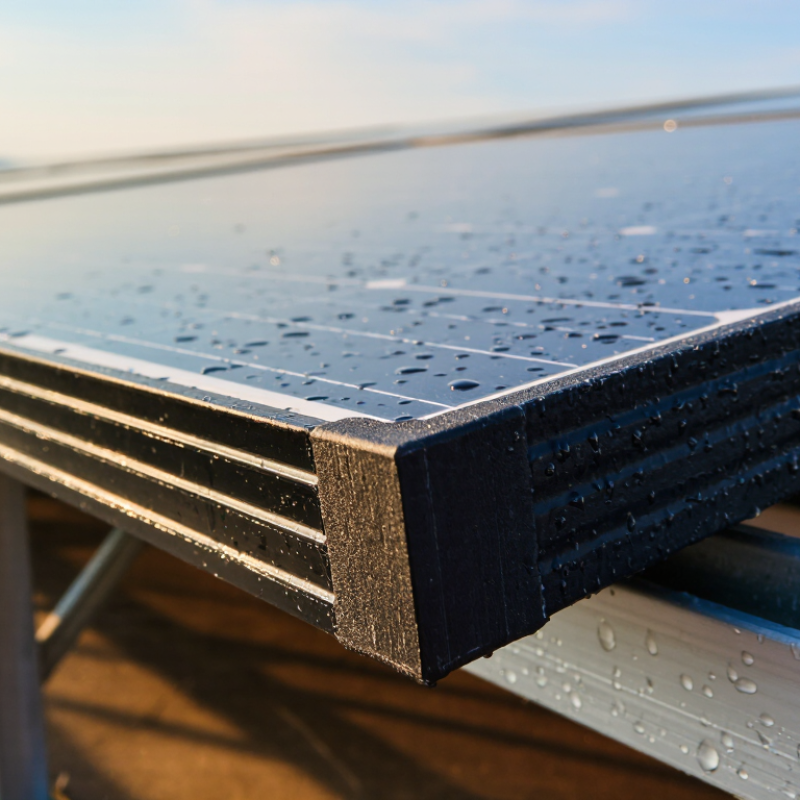
| Primary Function | Weather sealing, cushioning, vibration reduction, and electrical isolation | Continuous sealing around frames, glass edges, junction boxes, and cable-entry points | A gasket helps prevent water, dust, insects, and condensation from reaching sensitive components. |
| Common Material | EPDM rubber | Good resistance to ultraviolet radiation, ozone, moisture, and outdoor weathering | A practical general-purpose choice for exterior solar-panel sealing applications. |
| High-Temperature Material | Silicone rubber | Often suitable for approximately −50°C to 200°C, depending on formulation and certification | Useful where panels experience high temperatures, strong sunlight, or large thermal cycling. |
| Flexible Thermoplastic Option | TPE or TPV | Good flexibility and processability; temperature and weathering performance depend on grade | Can support custom profiles, efficient extrusion, and recyclable production workflows. |
| Material to Use with Caution | Natural rubber or general-purpose rubber | Outdoor durability varies and may be lower under prolonged UV, ozone, and heat exposure | These materials may harden, crack, or lose elasticity sooner if not specifically formulated for outdoor use. |
| Operating Temperature | Select a grade rated above the expected minimum and maximum temperatures | Outdoor systems may experience approximately −40°C to 85°C or higher at exposed surfaces | Adequate temperature margin helps prevent brittleness, softening, shrinkage, and loss of sealing pressure. |
| UV and Ozone Resistance | EPDM, silicone, or UV-stabilized TPE | Should be verified through the material grade and relevant weathering tests | Solar gaskets are continuously exposed to sunlight and atmospheric ozone, which can degrade unsuitable elastomers. |
| Hardness | Typically 60–80 Shore A for many frame and edge-sealing profiles | The exact value depends on groove geometry, compression, and required flexibility | Softer materials conform well to irregularities; harder materials can provide stronger support but need accurate dimensions. |
| Compression Ratio | Use the profile manufacturer’s design recommendation; avoid over-compression | Many rubber sealing profiles operate around 15%–30% compression, depending on design | Insufficient compression may leak, while excessive compression can cause installation damage and permanent deformation. |
| Compression Set | Choose a low-compression-set grade for long-term sealing | Compare test results at the intended temperature and exposure duration | Low compression set helps the gasket retain sealing force after years of clamping and thermal cycling. |
| Water and Dust Protection | Closed-cell or properly compressed elastomeric sealing profile | Protection level depends on the complete enclosure design, joints, drainage, and installation quality | A gasket alone does not determine ingress protection; the assembled system must be tested as a whole. |
| Chemical Compatibility | Check compatibility with cleaning agents, sealants, adhesives, oils, and mounting materials | EPDM generally performs well with water-based fluids but has limited resistance to petroleum oils; silicone compatibility varies | Chemical attack can cause swelling, softening, cracking, or loss of adhesion. |
| Electrical Insulation | Electrically insulating, non-conductive elastomer | Verify dielectric strength, volume resistivity, and applicable photovoltaic safety requirements | The gasket should not create an unintended conductive path near energized components. |
| Profile and Dimensions | Match the groove width, depth, corner radius, glass thickness, and frame geometry | Dimensional tolerances should be confirmed by drawings or sample fitting | Even a high-quality material may leak if the profile is too large, too small, or incorrectly fitted. |
| Installation Method | Dry-fit, press-fit, adhesive-backed, or mechanically retained profile | Allow for thermal expansion and avoid stretching the gasket during installation | Stretching, twisting, sharp bends, and contaminated surfaces can create gaps and premature failure. |
| Environmental Exposure | Select for the site climate: coastal, desert, high-altitude, humid, snowy, or industrial | Consider salt spray, sand abrasion, freeze–thaw cycles, humidity, and pollutants | The correct material depends on the actual installation environment, not only on the panel location. |
| Testing and Compliance | Request material datasheets, aging data, dimensional inspection, and relevant photovoltaic test evidence | Tests may include UV aging, heat aging, ozone exposure, compression set, flammability, and water ingress | Independent test data is more reliable than a material name or an unverified service-life claim. |
| Recommended Selection Priority | Compatibility first, dimensions second, installation and cost third | Confirm material, temperature, weathering, compression, profile, and test requirements before ordering | A lower initial price is not beneficial if the gasket causes leakage, corrosion, or repeated maintenance. |

.svg)