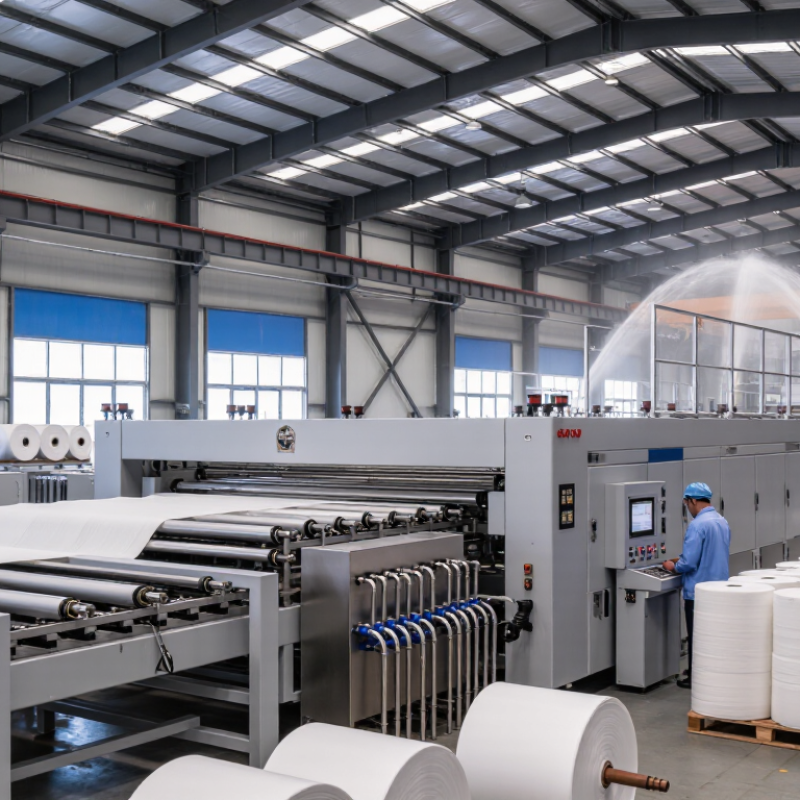
| Relevant Industry Experience | Experience with complete spunlace or hydroentanglement production lines, including web forming, water-jet entanglement, dewatering, drying, winding, and utilities. | Project list, commissioning records, references for similar fiber types and product widths, and production-line photographs. | 20% | The manufacturer can demonstrate completed projects with comparable output, raw materials, working width, and end-use requirements. |
| Process Engineering Capability | Ability to control key hydroentanglement variables such as water pressure, nozzle configuration, line speed, web uniformity, dewatering, and drying. | Process-flow diagram, equipment specifications, trial reports, control philosophy, and sample testing data. | 15% | The proposal explains how machine settings are adjusted for different fibers, basis weights, strength targets, and absorbency requirements. |
| Product Quality and Uniformity | Stability of basis weight, tensile strength, elongation, thickness, moisture, appearance, and roll quality across the working width. | Factory acceptance test plan, inspection records, laboratory methods, calibration records, and sample rolls. | 15% | Quality requirements are defined with measurable tolerances and verified during a documented factory and site acceptance test. |
| Mechanical and Electrical Quality | Structural strength, corrosion resistance in wet areas, component protection, electrical-panel workmanship, sensors, drives, and automation integration. | Bill of materials, engineering drawings, electrical schematics, inspection checklist, component datasheets, and functional test results. | 12% | Critical components are traceable, wet-zone materials are appropriately selected, and the control system includes alarms, interlocks, and emergency stops. |
| Quality Management System | Documented control of design, purchasing, production, inspection, nonconformities, corrective actions, and customer complaints. | Valid ISO 9001 certificate, certification scope, issuing body, audit status, quality manual, and sample inspection records. | 10% | The certificate is current, covers the relevant manufacturing activities, and can be verified through the certification body. |
| Safety and Regulatory Compliance | Machine guarding, emergency-stop systems, electrical safety, noise and access risks, documentation, and destination-market requirements. | Risk assessment, declaration of conformity where applicable, safety-circuit drawings, user manual, test reports, and compliance checklist. | 10% | Safety documentation matches the supplied machine configuration and the legal requirements of the installation country. |
| After-Sales Service | Installation, commissioning, operator training, remote support, troubleshooting, spare-parts availability, and response procedures. | Service-level agreement, spare-parts list, training plan, support contacts, warranty terms, and escalation process. | 10% | Support responsibilities, warranty coverage, response times, and spare-parts lead times are stated in the contract. |
| Environmental and Occupational Practices | Water circulation and filtration, energy use, wastewater handling, workplace safety, and environmental management practices. | Utility-consumption estimates, water-treatment description, environmental permits where applicable, and ISO 14001 or ISO 45001 certificates if claimed. | 5% | The design clearly identifies water, energy, emissions, waste, and worker-safety controls relevant to the installation. |
| Commercial and Delivery Reliability | Quotation clarity, scope boundaries, delivery schedule, payment milestones, packaging, installation requirements, and change-control procedures. | Itemized quotation, project schedule, contract draft, production milestones, inspection plan, and logistics documentation. | 3% | Technical scope, exclusions, acceptance criteria, delivery obligations, and payment conditions are unambiguous. |

.svg)