| Elastomeric Mounts | Rubber or synthetic-elastomer elements bonded to metal plates, studs, or bushes. | Elastic deformation absorbs vibration and limits shock transmission. | Generally suitable for medium- to high-frequency vibration; performance depends strongly on compound and preload. | Small motors, pumps, fans, compressors, control panels, and general machinery. | Compact, cost-effective, corrosion-resistant options are available, and usually maintenance-free. | Check static load, dynamic load, compression or shear direction, temperature, oil exposure, and allowable deflection. |
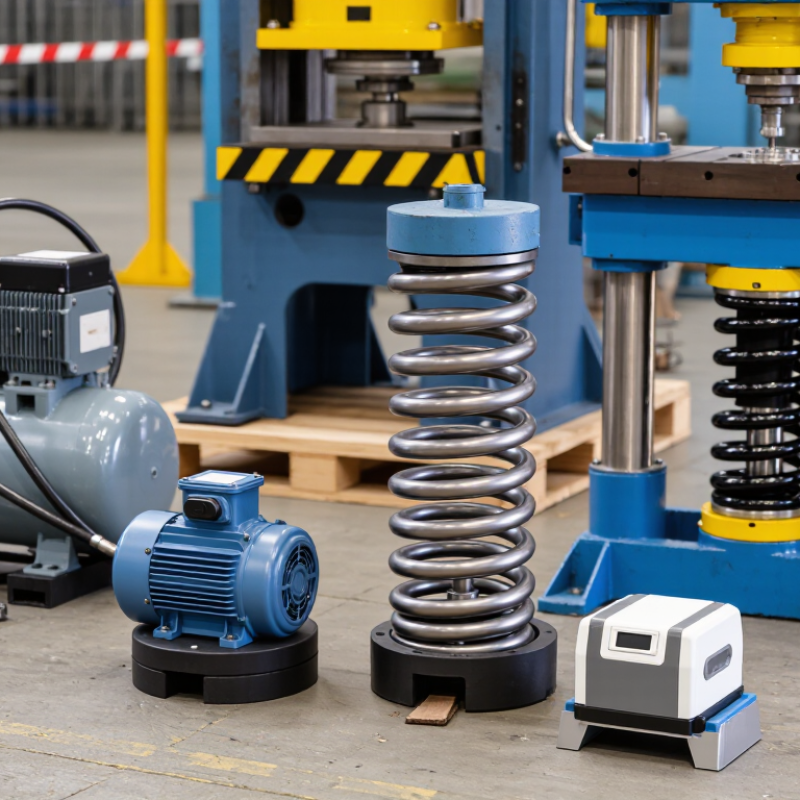
| Spring Mounts | Helical steel springs, often combined with housing, leveling hardware, or resilient pads. | Spring deflection lowers the natural frequency and reduces transmitted vibration. | Often effective for low-frequency vibration when sufficient static deflection is provided. | HVAC equipment, chillers, large fans, pumps, generators, and industrial machinery. | Handles high loads and can provide greater vertical movement than solid elastomer mounts. | Determine operating load per mount, required static deflection, lateral stability, seismic restraint, and possible spring surge. |
| Wire-Rope Isolators | Stainless-steel cable formed into loops and clamped between metal bars or frames. | Three-dimensional flexing of the cable dissipates vibration and absorbs shock. | Broad-band performance, including vibration and shock across multiple directions. | Outdoor equipment, transport systems, marine equipment, electronics, and applications with shock loads. | Resistant to oil, many chemicals, ozone, and temperature extremes; no fluid leakage and low maintenance. | Match the isolator to load direction, shock level, stroke limits, environmental exposure, and required preload. |
| Pneumatic Isolators | Pressurized air springs or air chambers supported by flexible diaphragms or bellows. | Compressed air provides a low-stiffness support with adjustable operating pressure. | Very low-frequency isolation is possible when correctly sized and controlled. | Precision measurement systems, optical tables, semiconductor equipment, and sensitive laboratory instruments. | Excellent low-frequency isolation and adjustable load capacity; leveling systems can improve stability. | Requires a clean, stable air supply or sealed system, height control, leak management, and protection from excessive motion. |
| Viscoelastic Mounts | Elastomer or polymer material designed to combine spring action with internal damping. | Material hysteresis converts part of the vibration energy into heat. | Effective over a defined frequency and temperature range; performance is material-dependent. | Electronic equipment, vehicle components, instrument panels, and structures requiring vibration damping. | Provides both support and damping, helping reduce resonance amplification. | Account for temperature, aging, frequency, strain amplitude, creep, and compatibility with chemicals or oils. |
| Neoprene or Rubber Isolation Pads | Flat pads, strips, or layered sheets made from resilient rubber or neoprene compounds. | Compression and shear deformation reduce structure-borne vibration and impact. | Typically used for medium- to high-frequency vibration and minor shock isolation. | Equipment bases, rail supports, pipe supports, building services, and low-profile machinery installations. | Simple installation, low profile, broad load-bearing area, and easy trimming or stacking. | Verify compressive stress, pad thickness, surface flatness, creep, temperature, and resistance to oil or weathering. |
| Hydraulic or Fluid-Damped Mounts | Elastomeric support combined with fluid chambers and calibrated passages. | Fluid movement through restricted passages provides frequency-dependent damping. | Useful where vibration characteristics vary with operating speed or load. | Engines, vehicle powertrains, rotating equipment, and systems requiring controlled resonance behavior. | Can reduce vibration across a wider operating range than a simple elastomer mount. | Consider fluid temperature, leakage risk, mounting orientation, dynamic load, service life, and maintenance access. |
| Hanger and Suspended Isolators | Spring, elastomer, or combination assemblies installed between suspended equipment and a supporting structure. | Separates suspended equipment or services from the structure to reduce transmitted vibration and noise. | Commonly selected for low- to medium-frequency building-service vibration. | Ductwork, pipework, suspended fans, air-handling units, and ceiling-mounted mechanical equipment. | Reduces structure-borne noise while accommodating overhead installation constraints. | Check hanger rod loads, vertical travel, lateral restraint, fire and building-code requirements, and installation alignment. |

.svg)