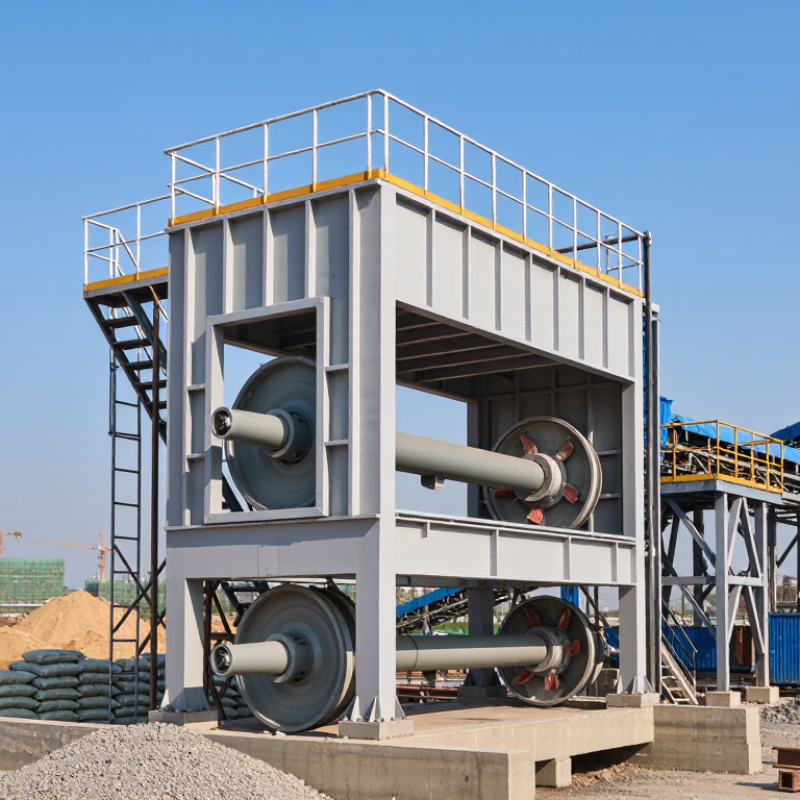
| Basic Classification | Mixer type | Twin horizontal shafts | Two counter-rotating shafts create overlapping mixing zones for intensive convection, shearing, and material exchange. |
| Capacity | Nominal discharge capacity | 1,500 L (1.5 m³) | The designation “1500” generally refers to the approximate rated volume of compacted fresh concrete discharged per batch. |
| Capacity | Theoretical hourly output | Approximately 60–75 m³/h | Actual production depends on loading, mixing, discharge, material characteristics, and the complete batching cycle. |
| Charging System | Typical charging volume | Approximately 2,400 L | The larger charging volume accommodates aggregates, cement, water, and admixtures before the mixture is compacted during blending. |
| Mixing Chamber | Main chamber construction | Heavy-duty welded steel body | The chamber supports the shafts and mixing tools while resisting abrasion, impact, and cyclic loads generated by aggregate movement. |
| Mixing Tools | Paddles and scraper arms | Replaceable wear-resistant components | Paddles lift and propel the material; scraper arms help move concrete away from the chamber walls and maintain mixing circulation. |
| Shaft Drive | Drive motor arrangement | Two geared electric drives | Independent or synchronized drives transmit high starting torque to the two shafts through reduction gearboxes and coupling components. |
| Drive Power | Typical total motor power | Approximately 55–60 kW | Power requirements vary with local electrical standards, concrete formulation, aggregate size, and the selected drive configuration. |
| Shaft Speed | Typical mixing speed | Approximately 25–30 rpm | The relatively low shaft speed combines high torque with controlled material movement, limiting excessive splashing and segregation. |
| Mixing Action | Material-flow pattern | Counter-current, three-dimensional circulation | Material is lifted, folded, and pushed along the chamber, promoting uniform distribution of cement paste, water, aggregates, and admixtures. |
| Aggregate Handling | Typical maximum aggregate size | Up to approximately 80 mm | The allowable size depends on the mixer design, paddle clearance, concrete recipe, and the requirements of the installation. |
| Discharge System | Discharge opening | Full-length bottom discharge gate | A broad bottom gate supports fast unloading and helps reduce retained concrete inside the mixing chamber. |
| Discharge System | Gate actuation | Hydraulic or pneumatic actuation | The actuator opens and closes the gate under load; the exact arrangement depends on the installation and control system. |
| Support Structure | Frame and mounting base | Rigid steel support frame | The frame distributes mixer weight and dynamic forces to the foundation while maintaining shaft and gearbox alignment. |
| Bearings and Seals | Shaft-end protection | Heavy-duty bearings with multi-stage seals | Bearing assemblies support radial and axial loads, while sealing systems reduce the entry of cement paste and abrasive fines. |
| Wear Protection | Common wear zones | Floor, side liners, paddles, and scraper tips | Replaceable liners and wear parts protect the chamber and help preserve the designed mixing clearance over time. |
| Batch Cycle | Typical complete cycle | Approximately 60–90 seconds | The cycle includes charging, mixing, and discharge; the required time changes with recipe, moisture, and automation settings. |
| Control System | Standard operating controls | Motor, gate, water, and safety interlock controls | Controls coordinate loading, mixing, discharge, emergency stopping, access-door monitoring, and overload protection. |
| Safety Design | Access and protection features | Inspection covers, guards, emergency stop, and interlocks | These features help prevent contact with moving shafts and tools and allow safer inspection, cleaning, and maintenance. |
| Typical Applications | Suitable concrete production | Ready-mix, precast, block, and infrastructure concrete | The twin-shaft configuration is suited to medium- and high-consistency mixes requiring fast and uniform blending. |

.svg)