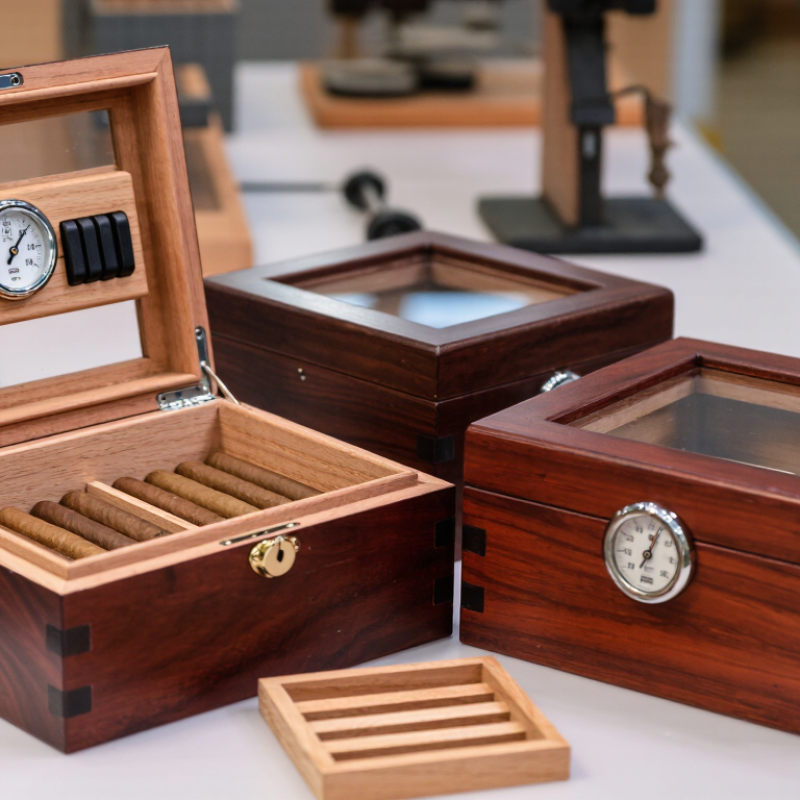
| Humidity Control | Stable storage is generally targeted at approximately 65%–72% relative humidity for premium cigars, depending on cigar type and user preference. | Request humidity-retention test results, calibration details for hygrometers, and a clear explanation of the humidification system. |
| Interior Wood | Spanish cedar is widely used because it supports aroma development, helps regulate moisture, and is traditionally associated with cigar storage. | Confirm the interior wood species, thickness, kiln-drying process, moisture content, odor control, and whether the wood is sustainably sourced. |
| Exterior Construction | Common constructions include solid wood, plywood with natural veneer, and engineered wood with decorative veneer. | Check the core material, veneer thickness, edge finishing, resistance to warping, and consistency between approved samples and mass production. |
| Airtightness | A well-designed box uses accurate joints, a continuous seal, and a lid that closes evenly without visible gaps. | Ask for leakage-testing procedures, seal material specifications, lid-alignment tolerances, and inspection records for finished units. |
| Humidity Capacity | Small desktop models commonly hold about 20–50 cigars, medium models about 50–150, and cabinet models more than 150. | Compare usable internal capacity rather than external dimensions, and verify shelf spacing, tray design, and airflow between storage levels. |
| Temperature Management | Traditional wooden humidors primarily control humidity; temperature stability usually depends on the storage environment. | For electronic or cabinet products, verify temperature-control range, operating noise, power requirements, backup protection, and safety testing. |
| Hardware and Fittings | Brass, stainless steel, zinc alloy, and coated metal are common choices for hinges, locks, handles, and corner fittings. | Review corrosion resistance, hinge-cycle testing, lock security, screw quality, plating consistency, and replacement-part availability. |
| Surface Finishing | Typical finishes include lacquer, polyurethane, oil, water-based coating, and natural veneer treatments. | Confirm finish durability, color consistency, surface smoothness, odor after curing, scratch resistance, and compliance with destination-market requirements. |
| Quality Control | A structured process normally includes incoming-material inspection, first-article approval, in-process checks, final inspection, and packaging verification. | Ask for documented inspection criteria covering dimensions, humidity performance, appearance, hardware operation, labeling, and carton condition. |
| Customization Capability | Professional manufacturers may support custom dimensions, wood species, finishes, logos, inserts, hardware, packaging, and electronic functions. | Evaluate engineering support, prototype lead time, mold or tooling charges, minimum order quantities, artwork approval, and change-control procedures. |
| Packaging Protection | Export packaging commonly combines individual protective wrapping, molded or foam cushioning, reinforced cartons, and moisture protection when required. | Request packaging drawings, drop-test or transit-test evidence, carton specifications, palletization details, and protection against abrasion and humidity. |
| Material and Chemical Compliance | Wood products may require legality documentation, and coatings, adhesives, and packaging may need to meet the regulations of the destination market. | Verify applicable wood-origin documents, formaldehyde or emissions reports, restricted-substance declarations, and buyer-specific compliance records. |
| Production Scalability | A reliable supplier should be able to maintain consistent quality from prototype quantities to repeat production orders. | Review production capacity, equipment, workforce organization, material-sourcing stability, lead-time history, and contingency planning. |
| Export Readiness | International orders typically require accurate commercial documents, export-safe packaging, product labeling, and coordinated freight planning. | Confirm experience with the destination country, shipping terms, carton marks, customs documentation, insurance options, and after-sales communication. |
| Warranty and After-Sales Support | Clear warranty coverage should define the period, covered defects, exclusions, response process, and remedy for verified quality issues. | Obtain written warranty terms, spare-parts policy, complaint-response timeline, replacement process, and responsibility for transport-related claims. |

.svg)