| Primary stainless steel grade | Austenitic 304 stainless steel typically contains approximately 17.5–19.5% chromium and 8.0–10.5% nickel. | Suitable for general household and food-service cookware because of its corrosion resistance, formability, and broad availability. | Typical chemical ranges are specified under ASTM A240 for 304 stainless steel products. |
| Premium corrosion-resistant grade | 316 stainless steel typically contains approximately 16–18% chromium, 10–14% nickel, and 2–3% molybdenum. | More appropriate for coastal, humid, or high-salt operating environments where improved pitting resistance is required. | Typical chemical ranges are specified under ASTM A240 for 316 stainless steel products. |
| Common retail capacity segments | 2–3 L, 4–6 L, and 8–12 L are widely used capacity bands for household and light food-service stew pots. | Small capacities support individual or two-person meals; medium capacities serve typical families; larger capacities target batch cooking and catering. | Capacity bands are commercial product-planning benchmarks rather than mandatory international classifications. |
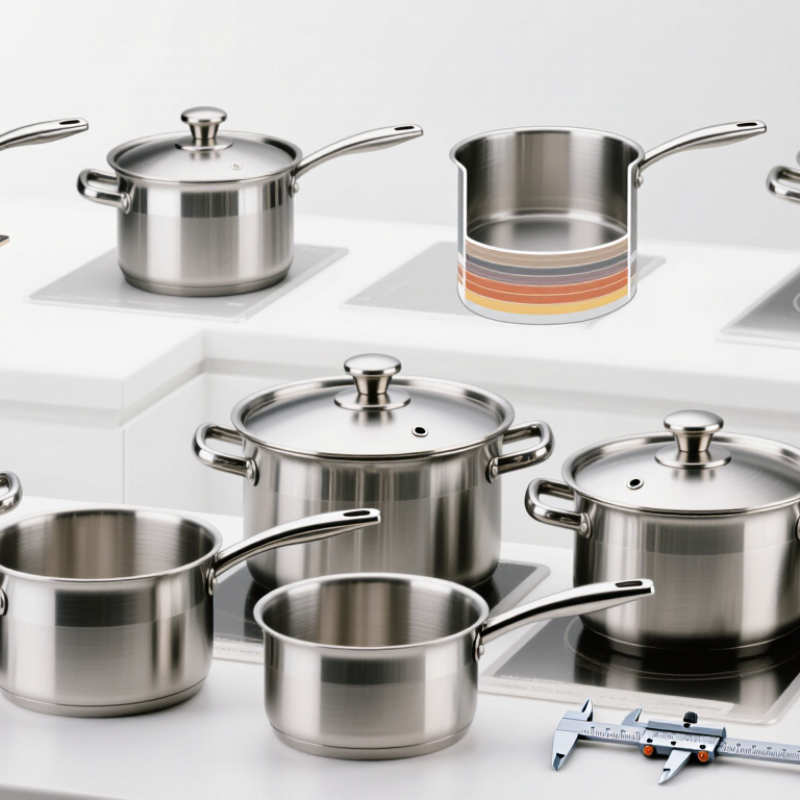
| Typical body construction | Single-layer bodies are commonly produced in approximately 0.5–1.0 mm sheet thickness; multi-layer constructions use a bonded aluminum or copper-containing core for heat distribution. | Buyers can balance unit cost, heating performance, weight, and durability according to the target retail segment. | Actual thickness depends on diameter, forming method, handle design, and requested performance specification. |
| Induction compatibility | A standard 304 stainless steel body is generally non-magnetic; induction use normally requires a magnetic stainless steel layer or a bonded ferromagnetic base. | Induction-ready construction expands compatibility across modern residential and commercial kitchens. | Compatibility should be confirmed through induction-heating tests on the finished pot, not inferred solely from the body grade. |
| Heating-surface design | Common designs include encapsulated bases, impact-bonded bases, and fully clad multi-layer bodies. | A thicker or multi-layer base generally improves heat spreading and reduces localized hot spots during simmering. | Thermal performance should be verified using heat-distribution and flatness testing on production samples. |
| Food-contact compliance | Products sold in the European Union are generally assessed under Regulation (EC) No. 1935/2004 and applicable food-contact good manufacturing practice requirements. | Compliance documentation supports customs clearance, retailer approval, and consumer-safety claims. | Requirements vary by destination market; buyers should request material declarations and test reports for the finished product. |
| Surface finish | Brushed, satin, polished, and mirror finishes are common commercial options for stainless steel cookware. | Satin and brushed finishes help reduce the visibility of scratches, while polished finishes emphasize shelf appearance. | Finish uniformity should be checked by visual inspection under consistent lighting and by comparing approved samples. |
| Lid configuration | Matching stainless steel lids and tempered-glass lids are the two principal configurations used in the global cookware market. | Glass improves cooking visibility, while stainless steel offers greater resistance to breakage and high-temperature handling. | Lid fit, steam ventilation, knob temperature resistance, and drop performance should be included in quality-control specifications. |
| Handle and attachment options | Common attachment methods include spot welding, riveting, and welded one-piece stainless steel handles. | Handle construction affects user safety, durability, cleaning, packaging dimensions, and long-term return rates. | Buyers should specify pull-force testing, sharp-edge inspection, heat resistance, and handle-to-body alignment. |
| Export quality-control checkpoints | Typical checkpoints include material verification, dimensional inspection, base flatness, surface inspection, handle strength, lid fit, and functional heating tests. | A defined inspection plan reduces batch variation across different production lots and destination markets. | Sampling levels and acceptance criteria should be agreed in the purchase contract before mass production. |
| Global demand drivers | Demand is supported by induction-cooktop adoption, preference for durable reusable cookware, household replacement cycles, food-service expansion, and demand for recyclable metal products. | Manufacturers serving multiple regions benefit from modular sizes, compatible bases, multilingual packaging, and adaptable compliance files. | Demand intensity varies by cooking culture, appliance penetration, purchasing power, and local food-contact regulations. |
| Recommended buyer specification set | Grade; body thickness; capacity; diameter; base structure; induction test result; surface finish; lid type; handle method; packaging; inspection standard; and destination-market compliance. | A complete specification enables comparable quotations and makes supplier capability easier to evaluate without relying only on catalog photographs. | Final values should be confirmed through an approved technical drawing, pre-production sample, and documented inspection report. |

.svg)