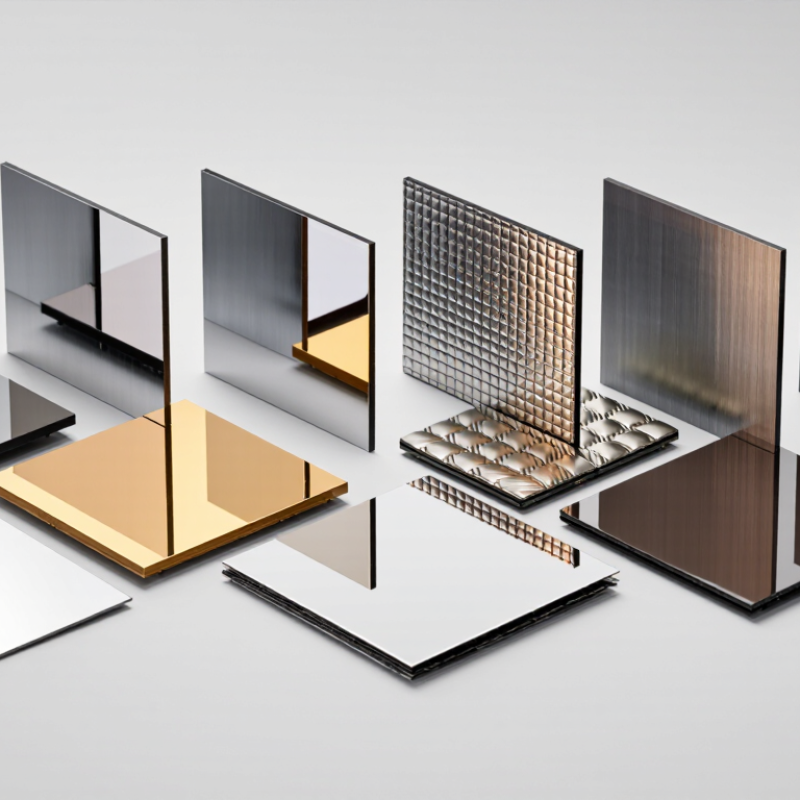
| 1 | No. 8 Mirror Polished Sheet | Progressive mechanical polishing using fine abrasives, followed by buffing. | Bright, near-mirror surface | 304, 316, 316L | Very high reflection when the surface is clean and free from scratches. | Architectural panels, elevator interiors, columns, decorative wall cladding, food-service areas. | The No. 8 designation is commonly used for highly reflective polished stainless steel, but finish quality is not identical among all suppliers. |
| 2 | 8K Mirror Sheet | Fine polishing and buffing intended to create a smooth, glossy surface. | Glossy mirror appearance | 304 and 316L are common; other austenitic grades may also be used. | High reflection with a relatively uniform visual finish. | Interior decoration, furniture panels, display areas, signage, ceiling features. | “8K” is a commercial finish term and should be confirmed with a physical sample or agreed inspection standard. |
| 3 | Super Mirror Sheet | Additional fine abrasive polishing and careful buffing beyond a standard mirror finish. | Sharper, clearer reflection | 304, 316L, and other corrosion-resistant stainless grades. | Extremely high visual reflectivity and improved image clarity compared with ordinary polished finishes. | Premium architectural interiors, luxury fixtures, feature walls, decorative doors. | It requires careful handling because fingerprints, transport marks, and fine scratches are highly visible. |
| 4 | Bright-Annealed Mirror-Like Sheet | Cold rolling followed by annealing in a controlled atmosphere that limits oxidation. | Smooth, bright, reflective | 304, 316L, 321, and similar heat-resistant or corrosion-resistant grades. | Reflective, but usually less optically mirror-like than a fully buffed No. 8 or super mirror finish. | Appliances, tubing-related components, clean equipment, kitchen and interior applications. | Bright annealed is a smooth mill finish; it should not automatically be treated as an optical mirror finish. |
| 5 | Colored Mirror Sheet | Mirror polishing followed by a colored surface treatment, commonly vacuum-deposited PVD coating. | Colored metallic reflection | 304 is widely used; 316L may be selected for higher corrosion resistance. | Maintains a reflective base while adding colors such as gold, bronze, black, blue, or other decorative tones. | Feature walls, retail interiors, hospitality spaces, furniture, decorative doors and panels. | Color durability depends on coating quality, cleaning chemicals, abrasion, and the installation environment. |
| 6 | Etched Mirror Sheet | A mirror-polished surface is chemically or mechanically etched in selected areas to create a design. | Mirror and matte contrast | 304 and 316L are common choices. | Unetched areas remain highly reflective, while etched areas provide a satin or matte contrast. | Decorative partitions, elevator panels, wall features, doors, screens, and interior graphics. | Patterns should be specified clearly because etching depth, texture, and contrast can differ significantly. |
| 7 | Embossed Mirror Sheet | A reflective sheet is mechanically textured with a raised or recessed pattern. | Reflective patterned relief | 304 and 316L; grade selection depends on corrosion and forming requirements. | Reflection is broken into highlights and shadows by the three-dimensional pattern. | Interior wall panels, ceilings, decorative furniture, elevator features, and architectural accents. | Embossing changes the flatness and may affect cutting, forming, cleaning, and protective-film removal. |
| 8 | Vibration-Finish Mirror Sheet | Mirror polishing is combined with controlled multidirectional polishing marks. | Random decorative movement | 304 and 316L are frequently selected. | Reflective overall appearance with irregular visual marks that reduce the prominence of minor handling scratches. | Wall cladding, elevator interiors, columns, reception areas, and decorative panels. | The pattern is intentionally non-directional; matching separate sheets may require production from the same batch. |
| 9 | Antique Mirror Stainless Sheet | A polished or colored reflective surface is selectively distressed, textured, or treated to create an aged appearance. | Aged, mottled reflection | 304 and 316L are typical substrates. | Moderate to high decorative reflection, intentionally interrupted by cloudy, worn, or irregular areas. | Feature walls, hospitality interiors, restaurants, retail displays, furniture, and decorative screens. | The aged effect is decorative rather than a sign of corrosion; cleaning and maintenance instructions should be followed carefully. |
| 10 | Perforated Mirror Sheet | A mirror-polished sheet is punched or laser-perforated with a regular hole pattern. | Reflective surface with openings | 304 and 316L are common; thickness and hole geometry depend on structural needs. | Reflective between perforations, with transparency, ventilation, or visual screening provided by the openings. | Decorative screens, ceilings, façades, balustrade infill, equipment covers, and interior partitions. | Perforation reduces the continuous reflective area and may create sharp edges unless the sheet is properly deburred. |

.svg)