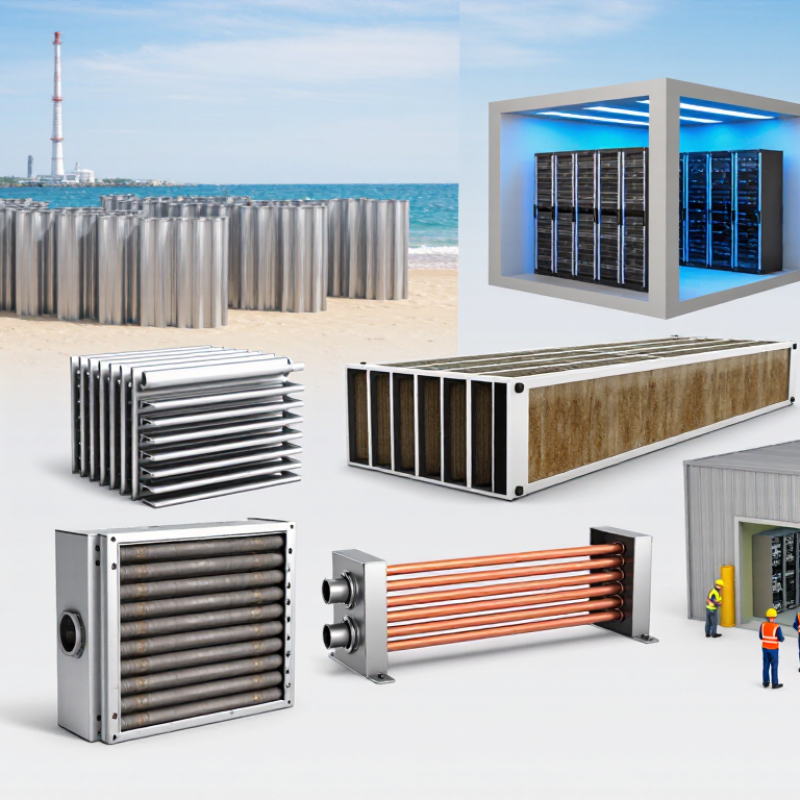
| Plate-Fin Air-to-Air Exchanger | Alternating layers of air passages separated by flat plates and corrugated fins; streams remain physically separated. | Sensible heat transfer through metal plates. | Ventilation heat recovery, data centers, industrial air systems, cleanrooms and building energy recovery. | Approximately 50–80% sensible effectiveness, depending on airflow arrangement, size and operating conditions. | Medium to high; the compact fin passages can increase resistance as airflow rises. | Compact design, no moving parts, no cross-contamination when properly sealed, and relatively low maintenance. | Usually transfers sensible heat only; frost, dust buildup and leakage control must be considered. |
| Crossflow Plate Heat Exchanger | Flat or profiled plates form perpendicular air channels, normally using aluminum, stainless steel or coated materials. | Sensible heat transfer across a stationary separating wall. | Commercial HVAC, residential ventilation, process exhaust recovery and air-handling units. | Commonly about 40–75% sensible effectiveness, subject to face velocity and exchanger geometry. | Low to medium, but increases with face velocity and filter loading. | Simple construction, low service requirements, and no rotating components. | Lower effectiveness than many counterflow designs; condensate drainage and freeze protection may be required. |
| Counterflow Plate Heat Exchanger | Two air streams travel in opposite directions through narrow, separated channels. | Sensible heat transfer through plates; some designs can transfer moisture when using a permeable membrane. | High-efficiency building ventilation, energy recovery ventilators and low-energy commercial facilities. | Approximately 60–90% sensible effectiveness for well-designed systems; actual values vary with airflow balance and temperature. | Medium to high because of the longer air path and compact passages. | High heat recovery potential, compact footprint and no moving parts. | More sensitive to fouling, frost and sealing quality; cleaning access may be limited. |
| Rotary Thermal Wheel | A rotating matrix wheel transfers heat between exhaust and supply air streams. | Regenerative heat transfer; hygroscopic media can transfer both sensible heat and moisture. | Large air-handling systems, commercial buildings, hospitals, airports and industrial ventilation. | Typically about 65–85% sensible effectiveness; total effectiveness depends on wheel coating, speed and humidity conditions. | Low to medium, with additional fan power from the wheel assembly. | High recovery efficiency, compact installation and optional latent heat recovery. | Contains moving parts; purge sections and proper sealing are important to reduce exhaust-air carryover. |
| Heat Pipe Heat Exchanger | Sealed tubes containing a working fluid, divided into evaporator and condenser sections by the air streams. | Passive two-phase heat transfer through evaporation and condensation. | Air preheating, air precooling, humidity-control systems, electronics cooling and heat recovery where the streams must remain separate. | Often about 45–75% sensible effectiveness, depending on tube arrangement, tilt and airflow conditions. | Low to medium. | No compressor or pump, no cross-contamination, and limited routine maintenance. | Sensible heat only in standard designs; performance can depend on orientation, refrigerant selection and operating temperature. |
| Run-Around Coil System | Two finned coils connected by a closed liquid loop containing water or a water-glycol solution. | Indirect sensible heat transfer through a circulating fluid. | Separated supply and exhaust systems, hospitals, laboratories, industrial ventilation and applications with strict contamination control. | Commonly about 40–70% system effectiveness; pump power and coil sizing influence the result. | Low to medium on the air side, plus hydraulic resistance in the fluid loop. | Air streams are physically isolated; coils can be located far apart and layout flexibility is high. | Requires pumps, controls, expansion provisions and freeze protection; additional power consumption is expected. |
| Finned-Tube Air Cooler | Process fluid flows inside tubes while ambient air passes over external fins, usually moved by axial fans. | Liquid-to-air or gas-to-air sensible heat transfer. | Petrochemical and chemical processing, power generation, refrigeration condensers, compressors and industrial cooling. | Performance is normally specified as heat-rejection duty rather than air-to-air effectiveness; capacity depends on fluid flow, ambient temperature and finned surface area. | Low to medium on the air side; process-side pressure drop depends on tube circuiting. | Uses ambient air instead of cooling water, reduces water consumption and supports large industrial duties. | Capacity falls at high ambient temperatures; fan noise, dust fouling and large footprint may be significant. |
| Forced-Draft Air-Cooled Heat Exchanger | Finned tube bundles positioned above or downstream of fans that force ambient air across the tubes. | Indirect sensible heat transfer from a process fluid to ambient air. | Industrial plants, refineries, gas processing, power stations and high-temperature process cooling. | Specified by process heat duty, outlet temperature and design ambient conditions rather than a single standard effectiveness value. | Medium, depending on fan selection, bundle geometry and airflow rate. | Reliable process cooling, accessible fan equipment and reduced risk of hot-air recirculation around the bundle. | Fan equipment is exposed to the environment; electrical consumption, noise and winter freeze protection require attention. |
| Induced-Draft Air-Cooled Heat Exchanger | Finned tube bundle with fans installed above the bundle to draw air through the heat-transfer surface. | Indirect sensible heat transfer from process fluid to ambient air. | Large process facilities, hydrocarbon cooling, condensers and applications requiring controlled airflow distribution. | Specified by process duty, approach temperature and ambient design conditions. | Medium to high because air passes through the bundle and fan system. | More uniform airflow, reduced hot-air recirculation risk and improved protection of fan motors from hot process air. | Higher structural elevation, more difficult maintenance access and potentially greater installation cost. |
| Direct-Contact Air Washer | Air contacts a water spray or wetted medium directly inside a chamber. | Combined sensible and latent heat and mass transfer. | Evaporative cooling, industrial humidification, air cleaning and selected HVAC processes. | Performance is described using cooling effectiveness, humidity change and water evaporation rate rather than dry heat-exchanger effectiveness. | Low to medium; pressure drop depends on eliminators, spray arrangement and wetted media. | Can cool and humidify air simultaneously, with potentially low electrical energy use. | Requires water treatment, drainage and hygiene management; direct contact may be unsuitable where air contamination must be avoided. |
| Selection note: Actual performance depends on airflow rate, inlet temperatures and humidity, allowable pressure drop, fouling level, materials, leakage requirements, climate and applicable safety standards. The ranges shown are indicative design values, not guaranteed ratings. |

.svg)