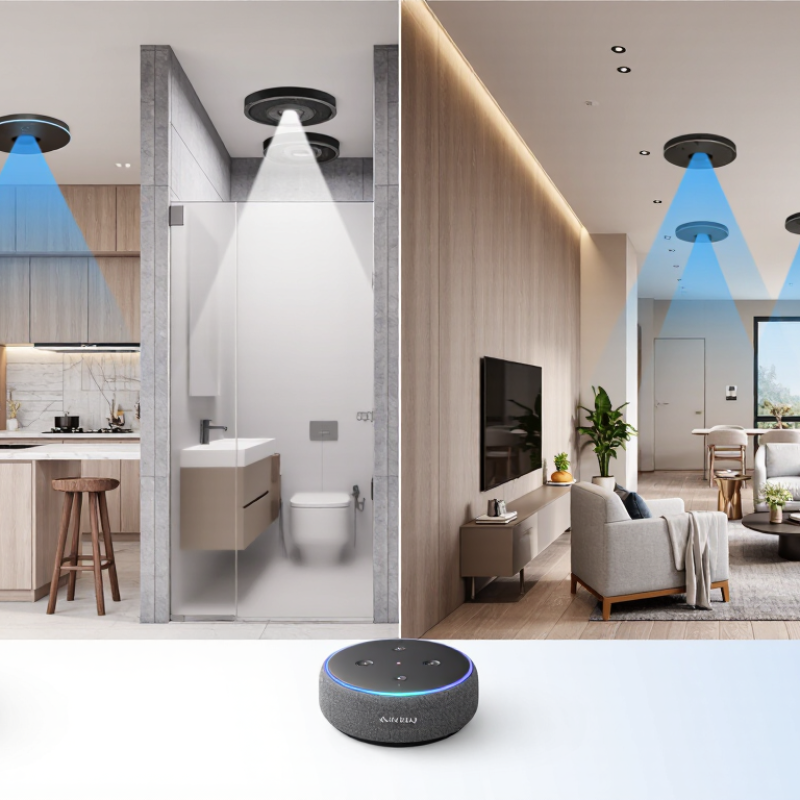
| Full-Range Fixed-Angle Speaker | One coaxial driver combines a woofer and a tweeter on a fixed axis. The tweeter is usually positioned in front of the woofer. | Broad and generally even coverage, with the strongest response directed toward the speaker axis. | Background music, distributed audio, speech, and general home entertainment. | Bedrooms, hallways, kitchens, offices, and rooms where the listening position is fairly predictable. | Simple design, compact installation, consistent phase alignment, and relatively easy system planning. | The fixed angle limits aiming flexibility, and high-frequency coverage can vary when listeners are far off-axis. | Versatile |
| Pivoting-Tweeter Speaker | A coaxial speaker with a tweeter that can be tilted toward the main listening area after installation. | More focused high-frequency coverage than a fixed model, with improved clarity away from the ceiling cutout. | Music and television audio in rooms with seating that is not directly below the speaker. | Living rooms, media rooms, dining rooms, and spaces with off-center seating. | Allows the treble to be aimed at listeners, helping compensate for irregular layouts and reflective surfaces. | The woofer remains largely fixed, and excessive aiming can make coverage less uniform across a large room. | Flexible |
| Angled-Woofer Speaker | The woofer and tweeter are mounted on a slanted baffle or angled enclosure to project sound toward a listening zone. | Directional, forward-aimed coverage that can reduce the need to place the speaker directly above the listener. | Front left, center, and right channels in an in-ceiling home theater system. | Media rooms where wall-mounted speakers are impractical and the screen or seating position is clearly defined. | Creates better front-stage imaging than a flat ceiling speaker when positioned and aimed correctly. | Less suitable for evenly distributed background audio; placement and orientation require careful planning. | Theater Focused |
| Dual-Voice-Coil Stereo Speaker | One ceiling enclosure contains two voice coils and usually two tweeter outputs, allowing one speaker to reproduce both stereo channels. | Wide coverage from a single location, but stereo separation is limited compared with two separate speakers. | Low-volume stereo music in compact areas where installing a pair is difficult. | Bathrooms, closets, hallways, small kitchens, and other narrow or single-speaker locations. | Saves ceiling space and avoids left-channel or right-channel imbalance in small rooms. | Lower stereo imaging, reduced power sharing between channels, and less ideal for critical listening. | Space Saving |
| High-Excursion Performance Speaker | Uses a larger woofer, a stronger motor structure, and greater cone travel to produce higher output and deeper mid-bass. | Typically wider and more controlled at higher volume, depending on the baffle and driver geometry. | High-level music playback, home theater effects, and rooms that need greater dynamic range. | Dedicated media rooms, large living areas, and open-plan spaces with elevated listening levels. | Higher output capability, improved dynamic impact, and better resistance to compression at demanding levels. | Requires more amplifier power, can need a larger ceiling cutout, and may transmit more vibration to the structure. | High Output |
| Moisture-Resistant Speaker | Uses corrosion-resistant materials, sealed or treated components, and finishes designed to tolerate humid conditions. | Usually broad and room-filling, with performance determined by the specific driver and grille design. | Background music and general audio in damp or temperature-variable environments. | Bathrooms, covered patios, kitchens, laundry rooms, and indoor pool-adjacent areas. | Better durability in humid locations and reduced risk of component corrosion. | Moisture resistance is not the same as complete waterproofing; direct water exposure may still be prohibited. | Damp Areas |
| Shallow-Profile Speaker | A reduced-depth enclosure and compact magnet structure are designed for ceilings with limited joist cavity space. | Varies by model; compact designs generally favor broad near-field coverage rather than long-distance projection. | Distributed music and speech where installation depth is the primary constraint. | Low-clearance ceilings, areas with ductwork, and renovation projects with restricted cavity depth. | Fits more locations and reduces conflicts with framing, pipes, and ventilation ducts. | Small enclosures may provide less bass extension and lower maximum output than deeper designs. | Renovation Friendly |
| In-Ceiling Subwoofer | A dedicated low-frequency driver is installed in the ceiling, normally with an enclosure or back box and a separate amplifier channel. | Low bass is relatively non-directional, while room placement and boundary effects strongly influence bass consistency. | Low-frequency reinforcement for music and home theater systems. | Media rooms and large rooms where a floor-standing subwoofer is undesirable or impractical. | Preserves floor space, provides a clean appearance, and can deliver substantial bass when properly enclosed and powered. | Installation is more complex, structural isolation is important, and bass correction may be needed to manage room modes. | Bass Expansion |
| Object-Based Surround Speaker | A wide-dispersion or aimable in-ceiling design is used to reproduce overhead effects in immersive multichannel audio. | Broad overhead coverage is preferred so multiple seats can perceive height information. | Height and overhead channels for immersive home theater formats. | Above or slightly forward of the main listening seats, following the processor and speaker-layout guidelines. | Provides convincing vertical effects and keeps the floor and walls visually uncluttered. | Placement is important, ceiling reflections can affect clarity, and it should not replace properly positioned main speakers. | Immersive Audio |

.svg)