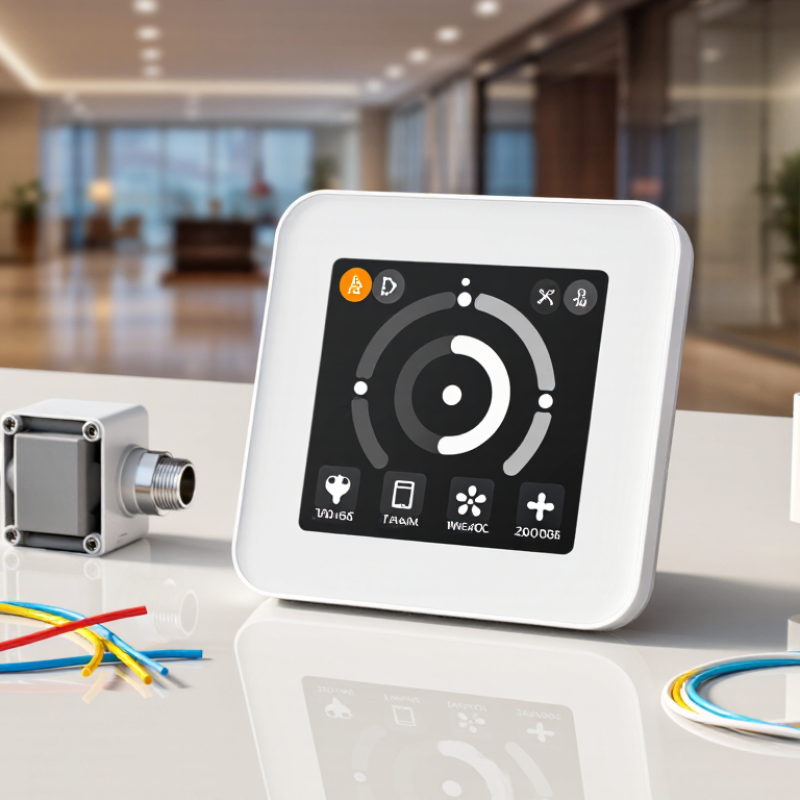
| Wireless Frequency | 2.4 GHz ISM band | Zigbee fan coil thermostats use the globally available 2.4 GHz industrial, scientific and medical radio band. The band is shared with technologies such as Wi-Fi and Bluetooth, so good channel planning and suitable placement are important. |
| Zigbee Network Type | Low-power wireless mesh network | Powered devices can generally act as routers, allowing messages to travel through multiple nodes to a coordinator or gateway. Battery-powered end devices normally conserve energy by remaining in sleep mode. |
| Typical Indoor Communication Range | Approximately 10–30 m per hop in many buildings | Actual range depends on walls, metal structures, floor layout, antenna design and radio interference. A mesh network can extend coverage beyond the direct range of one thermostat. |
| Security | AES-128 link-layer encryption with network authentication options | Secure commissioning, protected network keys and controlled joining procedures help reduce the risk of unauthorized access. Security settings should be configured by the building automation administrator. |
| Temperature Control | Room temperature sensing with configurable setpoint | The thermostat compares measured room temperature with the target setpoint and commands heating, cooling or fan operation. Sensor accuracy and installation location affect control quality. |
| Common HVAC Modes | Off Cooling Heating Auto Fan Only | Available modes vary by firmware and fan coil unit configuration. Auto changeover may require a suitable valve arrangement, changeover sensor or a supervisory control sequence. |
| Fan-Speed Control | Typical 3-speed control: Low, Medium and High | Some models also provide Auto fan operation or a variable-speed output. The thermostat output must match the fan coil unit’s relay, triac or controller interface. |
| Valve and Actuator Control | Commonly 2-pipe or 4-pipe fan coil configurations | Two-pipe systems typically use one heating or cooling water circuit, while four-pipe systems can provide separate heating and cooling circuits. Output type and actuator voltage must be checked before installation. |
| Typical Outputs | Relay, triac or low-voltage control outputs, depending on model | Output ratings are product-specific. The thermostat should not be connected directly to a load unless the rated voltage, current, inrush capacity and electrical protection are suitable. |
| Temperature Setpoint Range | Commonly around 5–35 °C, configurable by application | Commercial buildings often apply narrower user-adjustable limits to reduce energy waste and prevent extreme setpoints. The exact range is determined by the thermostat firmware. |
| Power Options | Low-voltage wired power or mains-powered designs | Fan coil thermostats that control valves and fan motors are commonly powered from the HVAC control circuit or a dedicated supply. The specified voltage must match the installation design. |
| Local User Interface | Buttons, touch controls, display and optional occupancy functions | Local controls may provide setpoint adjustment, mode selection, fan-speed selection, schedule override and fault indication. Interface features differ between product configurations. |
| Sensor Inputs | Internal room sensor; optional external or changeover sensor on some models | An external sensor can support remote temperature measurement, floor or pipe sensing, or water-system changeover detection when supported by the control design. |
| Commissioning | Network joining, device addressing and parameter configuration | Commissioning normally includes selecting the correct HVAC application, assigning the thermostat to a room or zone, setting fan and valve behavior, and verifying commands at the fan coil unit. |
| BACnet Connectivity | Usually achieved through a Zigbee-to-BACnet gateway | Zigbee and BACnet are different communication technologies. A gateway or building management controller typically maps thermostat values and commands into BACnet objects such as analog values, binary values and multistate values. |
| BACnet Transport | BACnet/IP or BACnet MS/TP, depending on the gateway | BACnet/IP commonly uses Ethernet or an IP network, while BACnet MS/TP uses an RS-485 bus. The gateway must support the required transport, object types and data-point mapping. |
| Typical BACnet Data Points | Room temperature, setpoint, operating mode, fan speed, valve command and alarm status | These points allow a building management system to monitor conditions, adjust operating parameters and coordinate fan coil operation with schedules, occupancy and energy-management strategies. |
| Interoperability | Dependent on Zigbee profile, device clusters, gateway support and implementation | Devices using the same radio frequency are not automatically interoperable. Confirm supported Zigbee profiles, endpoints, clusters, command formats and gateway compatibility before specifying equipment. |
| Energy-Saving Functions | Scheduling, occupancy setback, temperature limits and networked supervision | Energy performance depends on the complete HVAC sequence, valve control, fan strategy, ventilation requirements, building envelope and commissioning quality—not only on the wireless thermostat. |
| Installation Considerations | Correct wall position, clear airflow, reliable power and RF coverage | Avoid direct sunlight, drafts, heat-producing equipment, concealed obstructions and locations immediately beside doors or supply-air outlets. Perform a wireless survey in buildings with dense walls or metal partitions. |

.svg)