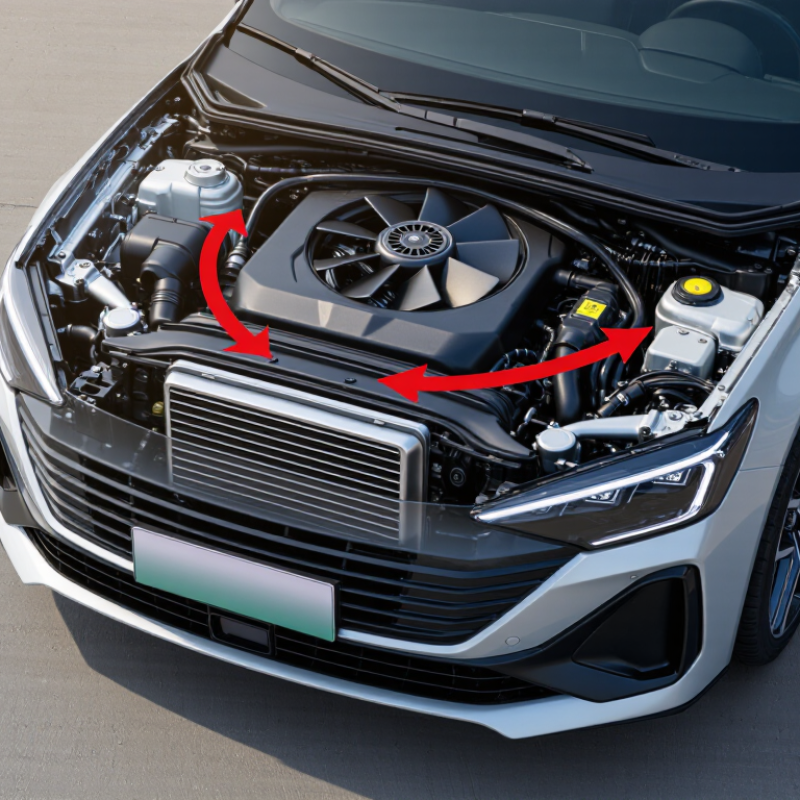
| Primary function | Moves outside air through the air-conditioning condenser. | Airflow helps the refrigerant release heat and condense from a high-pressure gas into a liquid. |
| Usual location | At the front of the vehicle, near the condenser and radiator, behind the grille. | The condenser is commonly positioned ahead of the radiator so incoming air can pass through it. |
| Mounting position | Mounted in front of the condenser as a pusher fan, or behind it as a puller fan. | The arrangement depends on vehicle packaging and airflow design. Some vehicles use more than one fan. |
| Fan assembly | Usually includes an electric motor, rotating blades, a protective shroud, mounting points, and an electrical connector. | The shroud helps direct airflow across the heat exchanger rather than around it. |
| Fan blades | Molded, curved blades made from a heat- and impact-resistant plastic are common. | Blade shape and rotation direction are designed to move air through the condenser efficiently. |
| Electric motor | Typically a 12-volt direct-current motor in passenger vehicles; designs may be brushed or brushless. | The vehicle’s control system may operate the fan at different speeds or vary its speed electronically. |
| Control inputs | Operation may be controlled using air-conditioning demand, refrigerant-pressure information, engine temperature, or a combination of inputs. | The fan may run when the vehicle is stationary or moving slowly, when natural airflow is limited. |
| Fan diameter | Varies by vehicle; passenger-car fan assemblies commonly fall within a broad range of roughly 250–400 mm. | This is a general reference, not a fitment specification. The original assembly and vehicle service information determine the correct size. |
| Electrical connection | Uses a vehicle wiring connector and a protected power circuit; the specific connector and circuit rating vary by design. | A failed fuse, wiring fault, control issue, or motor fault can prevent the fan from operating. |
| Common symptoms of failure | Weak air conditioning while stopped, rising engine temperature in traffic, unusual fan noise, or a fan that does not run when commanded. | These symptoms can have other causes too, so diagnosis should check the fan circuit and the rest of the cooling and A/C systems. |

.svg)