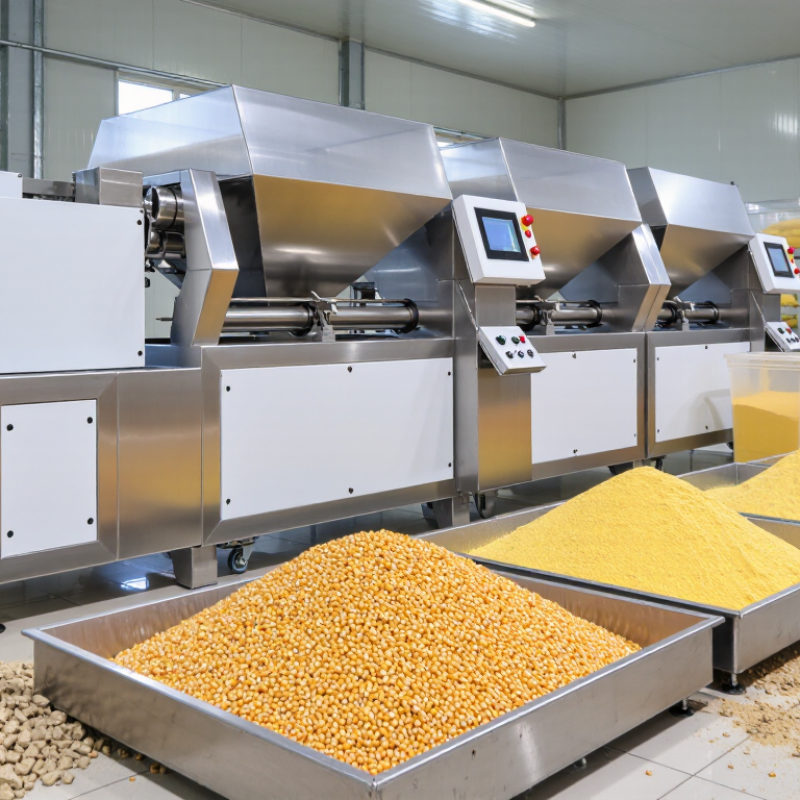
| What the machine does | A maize flour mill machine cleans, degerminates or dehulls when required, grinds, sieves, and collects maize flour. | Combines several processing steps in one production line and reduces manual handling. |
| Suitable raw material | Dry maize kernels with moisture commonly controlled at approximately 12%–14% before milling. | Stable moisture improves milling performance, flour consistency, and storage quality. |
| Small commercial capacity | Approximately 100–300 kg of maize per hour, depending on the machine configuration and product requirements. | Appropriate for local retail, small food processors, farms, and community milling services. |
| Medium-scale capacity | Approximately 500–1,500 kg of maize per hour, depending on the number of processing stages. | Supports wholesale supply, institutional buyers, and regional packaged-food distribution. |
| Industrial capacity | Generally above 2,000 kg per hour, with capacity determined by the complete plant design. | Provides continuous production for large-scale food manufacturing and commercial distribution. |
| Installed motor power | Small systems often use approximately 7.5–30 kW; larger systems may require 30–150 kW or more. | Helps buyers match the machine with available electrical capacity and operating costs. |
| Flour particle size | Many milling systems can produce flour in the approximate range of 100–500 micrometres by changing screens or settings. | Allows the same equipment to serve different recipes, markets, and customer preferences. |
| Product options | Depending on the process, outputs may include whole-maize flour, sifted flour, meal, grits, bran, and germ fractions. | Creates multiple revenue streams and improves utilization of the maize kernel. |
| Typical process stages | Cleaning → conditioning or moisture adjustment → degermination or dehulling → milling → sifting → packaging. | A defined process improves hygiene, repeatability, and control over final product quality. |
| Expected extraction rate | Flour and meal extraction commonly falls within approximately 65%–75% for degerminated products, depending on maize quality and specifications. | Provides a practical basis for estimating saleable output and by-product volumes. |
| Automation level | Options range from manually fed compact mills to automated systems with conveyors, sensors, control panels, and automatic bagging. | Enables the investment to match labor availability, production volume, and operating budget. |
| Hygiene and material construction | Product-contact areas are commonly made from food-grade stainless steel or coated carbon steel, depending on the machine section. | Smooth, accessible surfaces simplify cleaning and help reduce contamination risks. |
| Space requirement | Compact mills may fit in a small workshop, while complete medium and industrial lines require dedicated areas for processing, storage, and packaging. | Supports accurate planning of factory layout, material flow, and future expansion. |
| Main operating cost factors | Electricity, labor, raw maize, packaging, maintenance, replacement screens, and transport. | Makes it easier to calculate production cost, pricing, and expected payback. |
| Best reason to choose the machine | It offers scalable processing, consistent flour quality, improved labor efficiency, and the ability to produce several maize-based products. | A suitable machine can increase processing capacity and help a business respond to local demand. |

.svg)